In Karachi, the plot decides the house before the architect ever picks up a pencil. The width of your frontage decides whether you can park one car or three. The depth, after setbacks, decides whether you get a lawn or a light-well. The area, multiplied by the floors your zone allows, decides how many bedrooms you can actually fit, and the total covered area decides what the whole build will cost. Almost every disappointment we see on a Karachi project traces back to an owner who designed for the house they wanted instead of the plot they own.
This is the pillar guide to building on every standard Karachi plot size, from a compact 80 square yards up to a 1,000 square yard estate. For each size, we link to a dedicated guide covering the design realities, the structural and regulatory constraints, and the real 2026 cost. Read this page to understand how size changes the game; then go deep on yours.
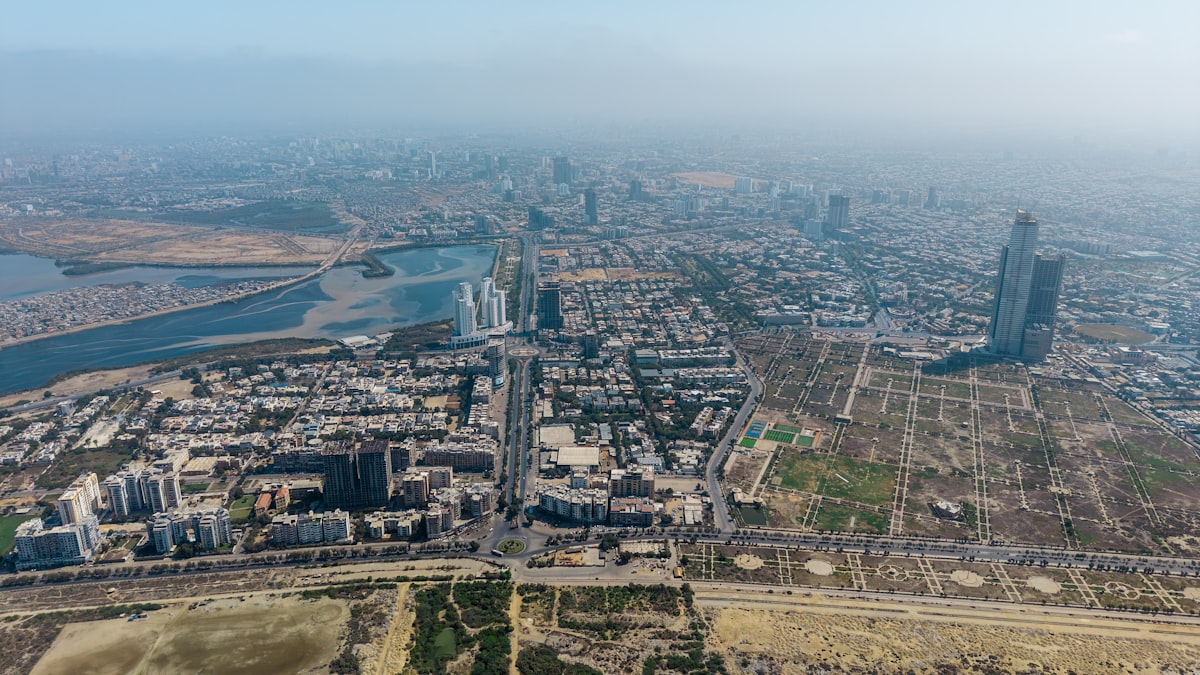 Karachi's housing stock spans an enormous range of plot sizes, and each size is a genuinely different building problem, not just a bigger or smaller version of the same house.
A Note on Units: Square Yards, Marla, and Square Feet
Karachi runs on square yards (often spoken as gaz). When a Karachiite says "a 240", they mean a 240 square yard plot, not 240 square feet, and not marla. Marla and kanal are Punjab units that show up mostly in finance ads and DHA paperwork. Because the same plot gets described in all three units, here is the conversion you can rely on throughout this cluster:
| Plot (Sq Yards / Gaz) | Sq Feet | Marla / Kanal (approx.) | Typical Dimensions (ft) |
|---|---|---|---|
| 80 | 720 | ~3.2 marla | 20 × 36 |
| 120 | 1,080 | ~5 marla | 30 × 36 |
| 200 | 1,800 | ~8 marla | 30 × 60 |
| 240 | 2,160 | ~10 marla | 40 × 54 or 36 × 60 |
| 300 | 2,700 | ~12 marla | 45 × 60 |
| 400 | 3,600 | ~16 marla | 50 × 72 or 40 × 90 |
| 500 | 4,500 | 1 kanal | 50 × 90 |
| 600 | 5,400 | ~1.2 kanal (24 marla) | 60 × 90 |
| 1,000 | 9,000 | ~2 kanal (40 marla) | 75 × 120 or 90 × 100 |
One square yard equals nine square feet. The marla figures use the Karachi convention of 25 sq yards to a marla and 500 sq yards to a kanal, the same convention used across this site. The dimensions are the common layouts in Karachi's KDA-era schemes, not a rule: corner plots, older subdivisions and newer schemes vary, so take your exact width and depth from the lease or the society's layout plan before any design work starts.
Marla in Gaz: The Quick Conversion
The question "how many gaz is 10 marla in Karachi?" has two honest answers, because two marla sizes are in use:
| Marla | Karachi / Society Convention (25 gaz per marla) | Revenue Marla (272.25 sq ft, ~30.25 gaz) |
|---|---|---|
| 3 marla | 75 gaz | ~91 gaz |
| 5 marla | 125 gaz | ~151 gaz |
| 10 marla | 250 gaz | ~302 gaz |
| 1 kanal (20 marla) | 500 gaz | ~605 gaz |
In Karachi practice, plots are bought, sold and approved in square yards, and the marla labels attached to them in ads ("120 gaz, 5 marla", "240 gaz, 10 marla") are rounded shorthand. If a document or a loan application quotes marla, check which marla it means before you compare prices or covered areas.
Plot Categories: What "A", "B" or "R" Category Means
In the older KDA schemes, plots were allotted by lettered category rather than by size, and the letters still appear on leases and in sale ads. In Federal B. Area and North Nazimabad the published layouts use:
| Category | Plot Size |
|---|---|
| R | 120 sq yd |
| A | 240 sq yd |
| B | 400 sq yd |
| C | 600 sq yd |
| D | 1,000 sq yd |
| F | 2,000 sq yd (North Nazimabad) |
These letters are scheme-specific, not citywide. Other schemes and later subdivisions use their own lettering, and categories such as E, L or SB carry different meanings depending on where the plot is, so the lettering on one lease tells you nothing about a plot in another scheme. The lease, allotment order or the society's layout plan is the only reliable source for your plot's actual area. Our F.B. Area and North Nazimabad guides cover building on these schemes in detail.
The Three Things Plot Size Actually Controls
Before the size-by-size guides, understand the three levers every plot size pulls. These are what make a 120 and a 240 fundamentally different houses, not just different budgets.
1. Covered area, and therefore cost. Your building cost is, to a first approximation, your covered area multiplied by your per-square-foot rate. Covered area is not your plot area: it is the footprint you are allowed to build (plot minus mandatory setbacks) multiplied by the number of floors. A 200 sq yard plot built ground-plus-one yields roughly 3,000 sq ft of covered area; the same plot built ground-only yields half that. This is why "cost per square yard of plot" is a meaningless number and "cost per square foot of covered area" is the only one that matters. Our house construction cost in Karachi 2026 guide sets out the current per-sq-ft rates by quality tier that every size guide in this cluster builds on.
2. Ground coverage and setbacks, and therefore your usable footprint. The SBCA (and, in DHA, DHA Town Planning & Building Control) mandates setbacks, the gaps you must leave between your building and the plot boundary. On a small plot these are brutal: a 4-foot front setback on an 80 sq yard plot can erase a fifth of your ground floor. On a 1,000 sq yard plot the same setbacks are absorbed comfortably and even become the garden. As plots get larger, you keep a higher percentage of usable footprint while gaining the room for lawns, parking, and light, which is why large plots feel disproportionately more spacious than the area difference alone suggests.
3. Permitted floors, and therefore how you grow. Karachi residential zoning typically permits ground-plus-one (G+1) as a baseline, with ground-plus-two (G+2) and basements allowed in many zones and on larger plots, subject to height limits and your approved building plan. On a small plot, building up is the only way to get the space you need, which makes the staircase the most important design decision in the house. On a large plot, you have the luxury of spreading out. Always confirm the permitted height and floor count for your specific plot with your approved plan before you design; it varies by zone, road width, and authority.
House Construction by Plot Size, The Size-by-Size Guides
Each guide below covers the same four things for that specific size: what realistically fits (rooms, parking, lawn), the structural and design constraints unique to that size, the SBCA/DHA regulatory limits, and the real 2026 cost range across quality tiers.
Compact Plots, Where Every Inch Is a Decision
- 80 Square Yard House Construction in Karachi, Karachi's smallest standard plot (~3.2 marla). The car-versus-room battle, side-staircase planning, the rental-portion income model, and how to bring light into a plot hemmed in on both sides. Found across Nazimabad, North Karachi, Surjani, Korangi, and Gulshan's smaller blocks.
- 120 Square Yard House Construction in Karachi, the volume seller and the "5 marla" plot. Where a proper porch, a small lawn, and a comfortable three-bedroom layout first become possible, and the size most often built under the PM's Apna Ghar finance scheme.
Mid-Size Plots, The Family-Home Sweet Spot
- 200 Square Yard House Construction in Karachi, the middle-class benchmark. Separate drawing and family lounges, four bedrooms, a real lawn, and a rooftop servant quarter all fit. The most-built family house in Gulshan, PECHS, and North Nazimabad.
- 240 Square Yard House Construction in Karachi, the "10 marla" plot. The extra width over a 200 unlocks a genuine double-car porch and a side passage, making this the most flexible mainstream Karachi size. Common in DHA's smaller plots, Gulshan, and Bahria Town.
Large and Luxury Plots, Architect-Led Territory
- 300 Square Yard House Construction in Karachi, the step into upper-middle and lower-luxury. Five bedrooms, a double-height entrance, formal and family living separated, and enforced setbacks that finally shape the design rather than just shrink it.
- 600 Square Yard House Construction in Karachi, full luxury-villa territory. Lifts, basements, a swimming pool, home theatre, and the MEP complexity (central HVAC, automation, solar) that turns construction into a coordinated multi-trade programme. DHA Phase 5–8 and Clifton.
- 1,000 Square Yard House Construction in Karachi, the 2-kanal estate. Signature homes with multiple living zones, basement entertainment and parking, deep foundations, mandatory soil investigation, and a full consultant team. Top-end DHA, Clifton Bath Island, and Khayaban addresses.
If your plot already has a structure on it, demolition is the phase before any of the above starts, and it scales with plot size in roughly the same bands. Our demolition cost guide gives realistic totals from 80 to 1,000 sq yd by structure type, and our single-storey vs multi-storey demolition guide covers the specific cost and timeline difference between tearing down a single-storey house and a double-storey one on the same plot.
What Fits on Each Plot Size, At a Glance
This table is the 30-second orientation. Each figure assumes a typical ground-plus-one build at standard specification; the detail (and the variation by area and floor count) is in each size's dedicated guide. Costs are construction only, excluding land, permits, and professional fees, at standard 2026 Karachi rates.
| Plot | Typical Covered Area (G+1) | Realistic Bedrooms | Car Parking | Lawn | Indicative Standard Cost (PKR) |
|---|---|---|---|---|---|
| 80 sq yd | ~1,200 sq ft | 2–3 (often as portions) | 1 (tight) | None / token | 65 lac – 90 lac |
| 120 sq yd | ~1,800 sq ft | 3 | 1 | Small | 95 lac – 1.35 cr |
| 200 sq yd | ~3,000 sq ft | 3–4 | 1–2 | Yes | 1.3 cr – 1.8 cr |
| 240 sq yd | ~3,500 sq ft | 4 | 2 | Yes | 1.6 cr – 2.1 cr |
| 300 sq yd | ~4,400 sq ft | 4–5 | 2–3 | Front + rear | 2.2 cr – 3.3 cr |
| 600 sq yd | ~8,500 sq ft | 5–6 suites | 3–4 | Landscaped | 6.5 cr – 12 cr+ |
| 1,000 sq yd | ~14,000 sq ft | 6–8 suites | 4–6 | Estate | 15 cr – 35 cr+ |
The cost jump from mid-size to luxury is steeper than the area jump, because larger plots are almost always built to a higher specification tier, imported materials, central air-conditioning, lifts, basements, and automation, not just to a bigger footprint. A 1,000 sq yard house is not five times a 200; it is a different category of building. See the premium and ultra-premium tiers in our cost guide for what drives that.
How Area Changes the Picture
The same plot size is a different project in different parts of Karachi, because the regulator, the soil, and the finishing expectations all change:
- DHA runs its own approval regime through DHA Town Planning & Building Control (not SBCA), enforces its setbacks and finishing standards strictly, and carries a 15–25% construction premium. See our construction company in DHA Karachi page.
- Clifton adds a coastal-corrosion problem to every structural decision, and foundation challenges near the sea on larger plots. Material specification has to account for salt-laden air.
- North Nazimabad, PECHS, and Gulshan are mid-market with good infrastructure and the most predictable SBCA approvals, the heartland of 120 to 300 sq yard family builds. Our North Nazimabad construction guide covers our home turf in detail.
- Bahria Town and Scheme 33 are newer, with developer/SBCA approval processes and value-oriented rates, common for larger plots bought to build.
The Constants, True at Every Plot Size
Whatever your plot, five things hold:
- Finalise the design before breaking ground. A change that costs PKR 50,000 on the drawing costs lacs once concrete is poured. This matters most on small plots, where there is no room to absorb a mistake.
- Insist on an itemised Bill of Quantities with named materials. A lump-sum quote is where mid-project "discoveries" and silent material substitution live. This is your single strongest protection at any budget. See how to choose a contractor in Karachi.
- Tie payments to verified progress, never to dates. And build a 15–20 day buffer into every phase, Friday stoppages, Eid shutdowns of one to two weeks, and monsoon disruption are part of every Karachi build calendar, not exceptions.
- Match the team to the plot. A skilled mistri team can deliver good grey structure on an 80 or 120. A 600 or 1,000 sq yard luxury build needs a project-managed company coordinating architects, structural and MEP consultants, and specialist trades, the gap between the two is where most large-project failures happen.
- Source materials where they are cheapest and most reliable, not just from one contractor. The same grade of steel, cement, tile, or fitting varies 10–30% in price across Karachi's supply zones, steel from Shershah and SITE, tiles and electrical from Jodia Bazaar and Bolton Market, timber from Essa Nagri. A builder with decades of supplier relationships across these zones secures the right specification at the right rate on your behalf, and the saving compounds as the plot gets larger.
Frequently Asked Questions, Building by Plot Size in Karachi
What is the most popular plot size to build a house on in Karachi? The 120 (≈5 marla) and 240 (≈10 marla) square yard plots are the two highest-demand mainstream sizes. The 120 is the entry-level family home and the most common size built under the PM's Apna Ghar finance scheme; the 240 is the upper-middle-class standard, offering a four-bedroom house with a double-car porch and a lawn.
How many gaz is 5 marla or 10 marla in Karachi? Under the Karachi and society convention of 25 gaz per marla, 5 marla is 125 gaz and 10 marla is 250 gaz. Under the revenue marla of 272.25 sq ft, they come to about 151 and 302 gaz. In everyday Karachi usage, a 120 sq yd plot is sold as "5 marla" and a 240 sq yd plot as "10 marla".
What are the dimensions of a 120 sq yard plot in Karachi? The most common layout is 30 ft × 36 ft (1,080 sq ft). A 200 sq yd plot is typically 30 × 60 ft, a 400 sq yd plot 50 × 72 ft or 40 × 90 ft, and a 1,000 sq yd plot 75 × 120 ft or 90 × 100 ft. Your lease or society layout plan gives the exact figures for your plot.
How much covered area can I build on my plot in Karachi? As a rule of thumb, your usable ground-floor footprint is your plot area minus mandatory SBCA/DHA setbacks, often around 80–85% on small plots, falling as plots get larger and setbacks grow. Multiply that footprint by your permitted number of floors (commonly G+1, sometimes G+2) to get total covered area. Always confirm the exact figures against your approved building plan, as they vary by zone and road width.
Do bigger plots cost more per square foot to build? Not because of size itself, but larger plots are almost always built to a higher specification (imported materials, central air-conditioning, lifts, basements), which raises the per-square-foot rate sharply. A standard 200 sq yard build runs PKR 5,000–7,500/sq ft; a luxury 1,000 sq yard build runs PKR 13,000–20,000+/sq ft. The specification, not the plot, drives the rate.
How many floors can I build in Karachi? Most Karachi residential zones permit ground-plus-one (G+1) as a baseline, with ground-plus-two (G+2) and basements allowed in many zones subject to height limits, road width, and your approved plan. DHA has its own height and floor rules by phase. Confirm your specific entitlement before designing, it is the single biggest factor in how much house your plot can yield.
Should I build the whole house at once or in phases? On small plots (80–120 sq yd) where rental income is a goal, building G+1 in one go and letting the upper portion is usually the strongest play. On larger plots, completing the grey structure of all floors together and finishing in phases is common and structurally sound, provided the foundation and columns are designed for the final floor count from day one. Designing for future floors you may never add wastes money; not designing for floors you will add wastes far more.
Build on Your Plot With Naffees & Sons
We have been building across Karachi since 1972, on plots from compact 80 square yard portions to 2-kanal luxury homes, with a government-audited track record and a seven-day operation that absorbs the idle-day losses baked into the Karachi market. Whatever your plot size, we will tell you honestly what fits, what it will cost, and where the constraints are, before you commit.
Book a Free Site Visit and Quote → | Chat on WhatsApp
Go to your plot size:
- 80 Square Yard House Construction
- 120 Square Yard House Construction
- 200 Square Yard House Construction
- 240 Square Yard House Construction
- 300 Square Yard House Construction
- 600 Square Yard House Construction
- 1,000 Square Yard House Construction
Building on a plot in one of Karachi's newer developing areas? See our Scheme 33 construction page for approvals, soil conditions and costs specific to that area.