SM Government Science College Renovation, Karachi – Major Renovation Programme (2004–05)
Shahrah-e-Liaquat, Saddar, Karachi — 2004–05
In 2004, the City District Government Karachi, through its Works & Services Department and the office of the District Officer Education Works-I, selected Naffees & Sons as the approved government contractor for renovation works at Sindh Muslim Government Science College on Shahrah-e-Liaquat. The contract value, across two formally sanctioned phases, was Rs.48,14,300, equivalent to approximately Rs.2.4 crore at current construction costs.
This was a government institutional contract executed under the Major Renovation in Existing 5 Colleges in Karachi Programme, a provincially funded initiative aimed at the most significant deferred maintenance across five of Karachi's major government colleges. Every rupee was sanctioned through the Works & Services Department, approved against the Composite Schedule of Rates set by the Standing Rates Committees of the Government of Sindh, and signed off by the District Officer. The paperwork is complete. The certificates are signed. The work was done.
The Programme and the Selection
The Major Renovation in Existing 5 Colleges in Karachi programme was not an open tender where any registered contractor could bid. It went to approved government contractors, firms that had already demonstrated to the Works & Services Department that they had the technical capacity, financial standing, and site management discipline to execute institutional renovation under live operational conditions, to government specification, on government timelines.
Naffees & Sons has held approved government contractor status in Karachi across multiple administrations, City District Government, Karachi Development Authority, Works & Services Department, and the education department frameworks that operated under them. That standing was built over decades, starting from the firm's earliest government contracts in the 1970s. The SM Science College engagement in 2004–05 is one project in a continuous record of government contract delivery that runs from the 1970s to the present.
Being selected for a programme covering five colleges across Karachi, rather than a single building, tells you something about the level of confidence the relevant departments had in the contractors they chose.
The Institution
Sindh Muslim Government Science College, on Shahrah-e-Liaquat in Saddar, is one of Karachi's most established government educational institutions. The college offers intermediate Pre-Medical and Pre-Engineering programmes across morning and evening shifts, drawing students from across the city.
The campus has multiple academic blocks, residential houses, and support facilities. The Hassan Ali Block and Khairpur House, the two structures this contract covered, are primary academic and support components. By 2004, both had accumulated the structural and maintenance deficits typical of government institutional buildings in Karachi that pass three to four decades without comprehensive renovation: deteriorated plaster, corroded pipework, degraded finishes, and a general condition that had begun to affect the usability of the buildings.
When a government science college, used daily by hundreds of students doing laboratory work, reaches a state of significant physical deterioration, the cost of further delay is not just financial. It is institutional. The Works & Services Department acted. We executed.
The Contract: Sanctioned Values and Documentation
The programme was divided into two formally issued contracts, each with its own government face sheet, rate specification, authority signature, and year of execution.
Phase 1, Khairpur House & External Development
Sanctioned Amount: Rs.36,96,000/- | Year: 2004
This phase covered the complete renovation of the science laboratories on the second floor of Khairpur House, the external walkways connecting the two main houses, the construction of new lavatory blocks, and all external development and landscaping works.
The contract was issued by the Office of the District Officer Education Works-I, Karachi, under authority of the Works & Services Department, CDG Karachi. The specification was Composite Schedule of Rates, approved by the Standing Rates Committee of the Government of Sindh, Revised 2004.
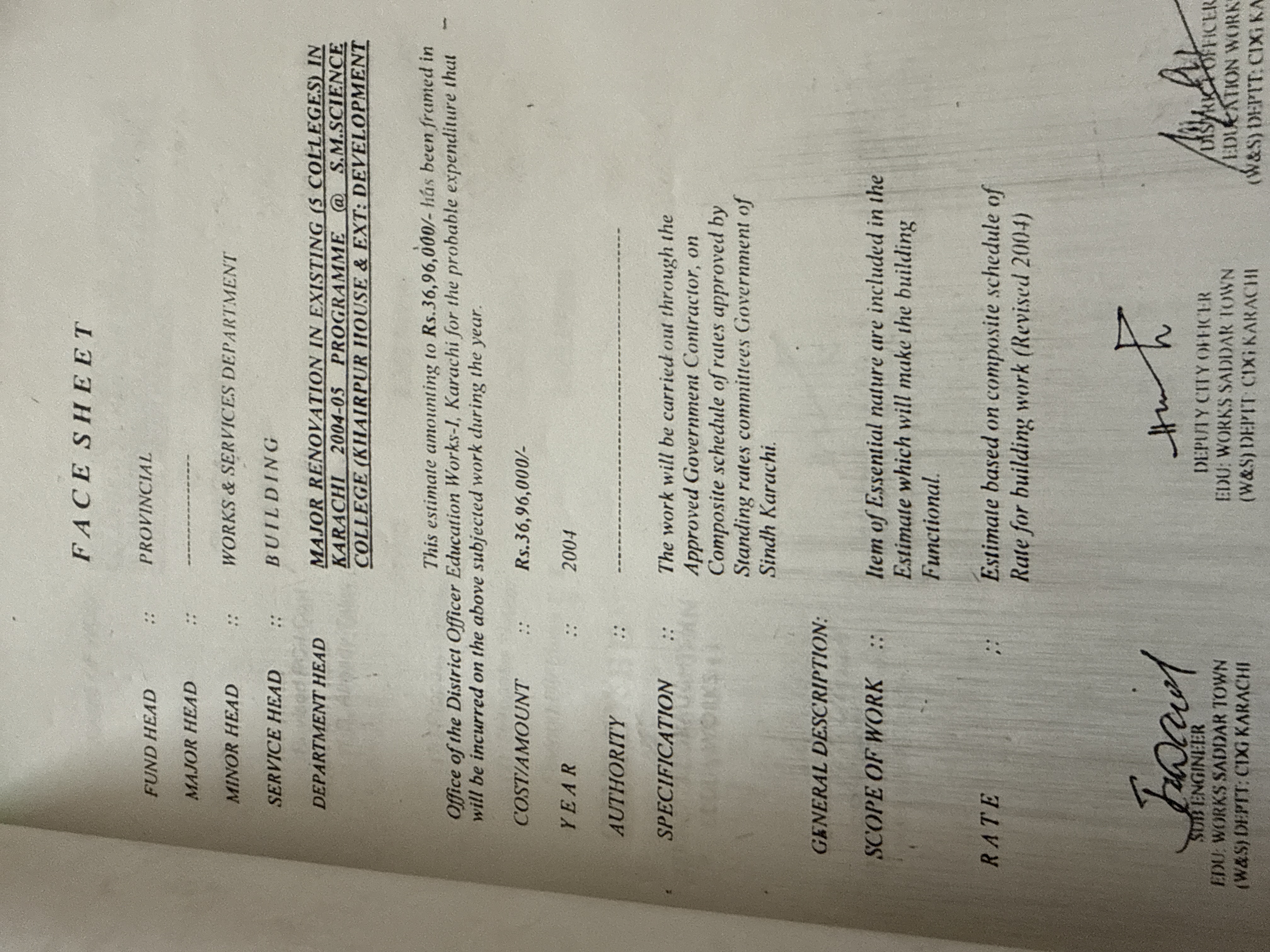 Government face sheet, Khairpur House & External Development. Sanctioned amount: Rs.36,96,000/-. Year: 2004. Signed by D.O. Education Works-I and Deputy City Officer, Works Saddar Town, W&S Deptt. CDG Karachi. Rate specification: Composite Schedule approved by Standing Rates Committee, Govt. of Sindh (Revised 2004).
Phase 2, Hassan Ali Block, Phase-IV
Sanctioned Amount: Rs.10,97,000/- → revised to Rs.11,18,300/- | Year: 2005
This phase covered the F-Floor and 2nd Floor of the Hassan Ali Block, a comprehensive scope including laboratory and classroom plaster, full UPVC pipe replacement, sewerage line construction, bathroom overhaul, facade sand blasting, painting, and woodwork.
The initial sanction of Rs.10,97,000 was formally revised to Rs.11,18,300, an increase of Rs.21,300 processed as a standard administrative variation through the District Government, with a signed approval letter issued separately.
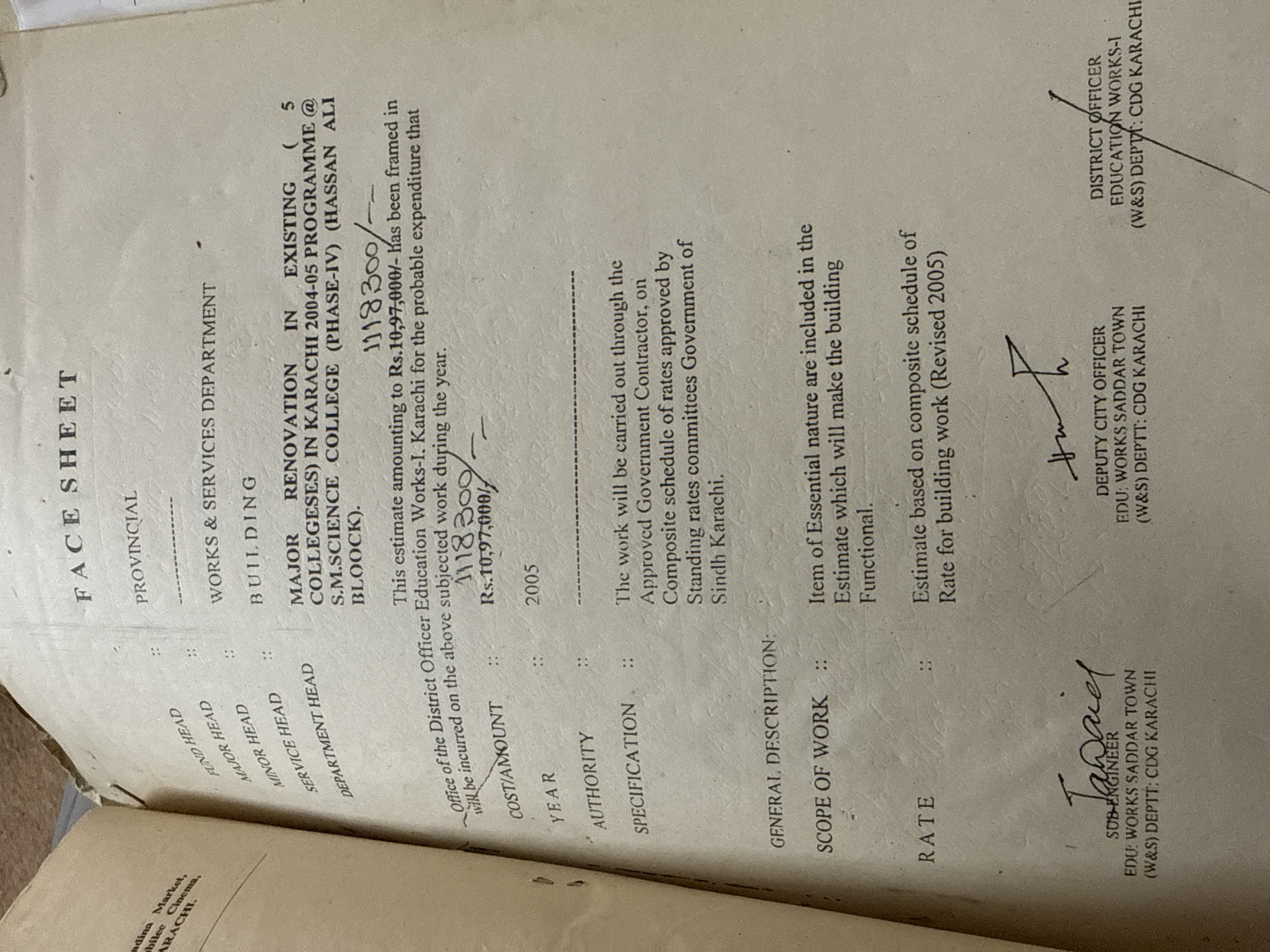 Government face sheet, Hassan Ali Block (Phase-IV). Initial sanction: Rs.10,97,000/-; revised to Rs.11,18,300/-. Year: 2005. Authority: D.O. Education Works-I (W&S) Deptt. CDG Karachi. Rate specification: Composite Schedule approved by Standing Rates Committee, Govt. of Sindh (Revised 2005).
The variation was not informally agreed or added to the bill retrospectively. It was processed correctly: a separate approval letter was issued through the District Government's Education Affairs & Services (Capital) account, formally sanctioning the revised amount before the additional work was carried out.
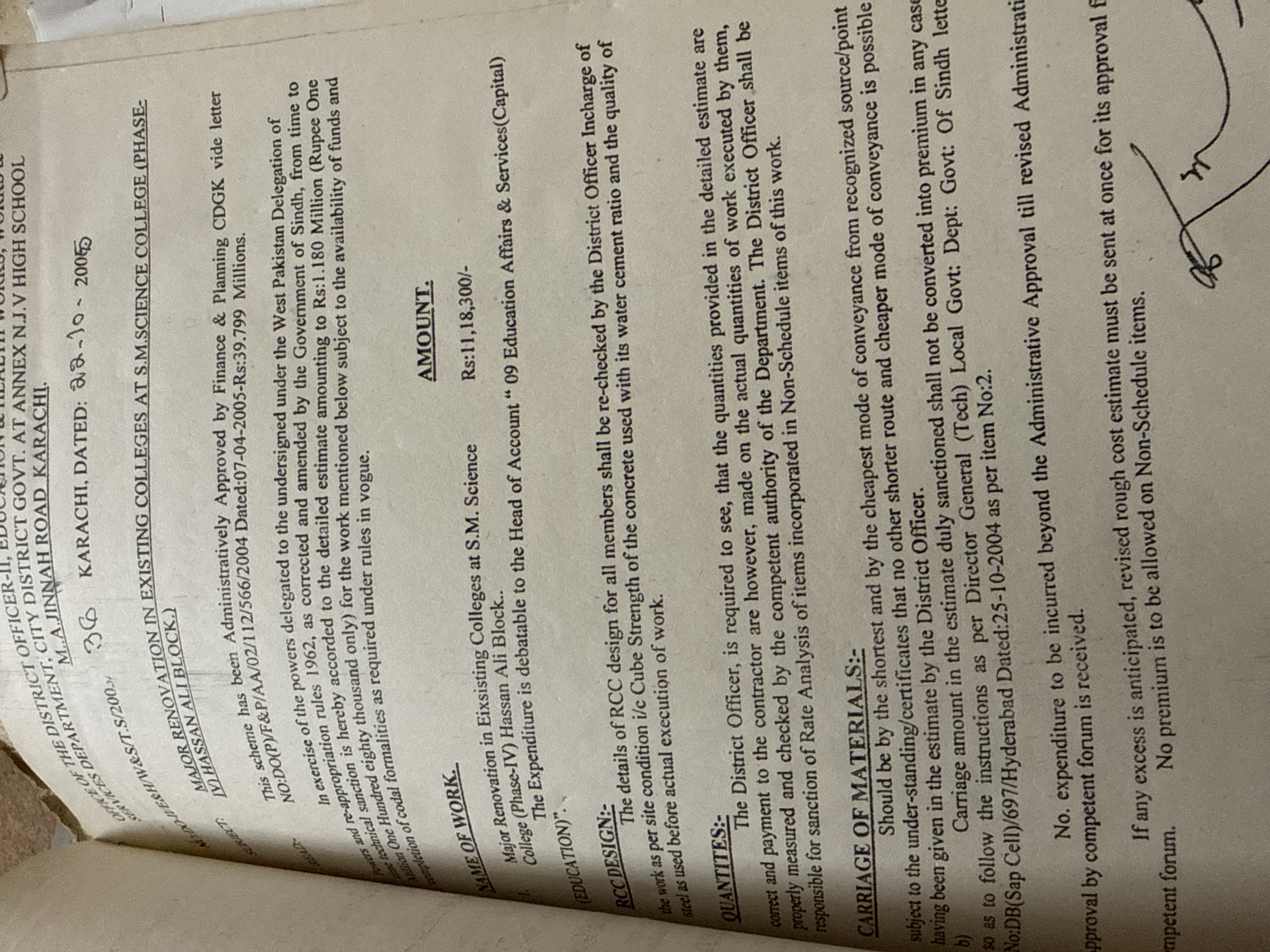 District Government of Karachi, administrative approval letter formally sanctioning Rs.11,18,300 for Hassan Ali Block (Phase-IV), SM Science College. Issued through Education Affairs & Services (Capital) Account. Signed by District Officer, Education Works-I, W&S Deptt. CDG Karachi. This is the standard process for variation sanction on government construction contracts.
Combined Contract Value, and What It Means Today
| Phase | Scope | Sanctioned Value |
|---|---|---|
| Khairpur House & External Development | Science labs, walkways, lavatories, landscaping | Rs.36,96,000/- |
| Hassan Ali Block Phase-IV (F-Floor + 2nd Floor) | Full interior renovation, UPVC pipe replacement, facade | Rs.11,18,300/- |
| Total | Both phases, SM Government Science College | Rs.48,14,300/- |
Inflation context: Between 2004 and 2025, Pakistan's CPI increased by approximately 5×, consistent with State Bank of Pakistan data on cumulative construction cost inflation over the period. Applying this multiplier to the 2004–05 contract values:
- Rs.36,96,000 in 2004 → approximately Rs.1.85 crore in 2026 purchasing power
- Rs.11,18,300 in 2004–05 → approximately Rs.56 lakh in 2026 purchasing power
- Combined total: approximately Rs.2.4 crore at 2026 construction costs
To be clear: Naffees & Sons was executing what is, in modern terms, a Rs.2.4 crore institutional renovation, on a government commission, under government supervision, at a live college, in 2004. This is not a footnote. This is the calibre of work we have been doing for government clients in Karachi for decades.
Scope of Work, Khairpur House & External Development (Rs.36,96,000/-)
Science Laboratories, 2nd Floor
The two science laboratories on the second floor of Khairpur House received complete renovation from floor to workstation. New RCC (reinforced cement concrete) tables were constructed, the fixed, heavy-duty laboratory workstation format that government science college laboratories have used for decades because it handles the physical demands of student laboratory work: weight, chemical spills, heat, and the general wear of high-occupancy institutional use.
The tables were finished with glazed ceramic tile surfaces, the practical choice for laboratory benches. Impermeable, cleanable, and resistant to the acids, solvents, and staining compounds that come with a Pre-Medical or Pre-Engineering chemistry and physics curriculum. The floor throughout both laboratories was finished in Verona marble, durable enough to still be serviceable decades later, and appropriate to the institutional standing of the college.
This was not a patch-and-paint laboratory renovation. It was a complete functional upgrade that gave the college laboratories that would actually serve students properly.
External Walkways
The walkways in front of both Khairpur House and Hasan Ali House, the main pedestrian routes connecting the two structures, were completely renovated with new tile flooring. Every student crossing between buildings uses these walkways multiple times a day. Surfaces that had cracked, heaved, or worn to a safety concern were fully replaced.
Lavatory Block Construction
Two new lavatory blocks were constructed: one at ground floor level and one at first floor level within Hasan Ali House. Both were fitted throughout with glazed tile work on wet surfaces, the correct specification for institutional washrooms that need to stay sanitary under high-volume daily use.
This was not repair of existing facilities. It was construction of new sanitary capacity within the existing building fabric. The college gained functional, well-specified bathrooms where previously there had been inadequate provision.
External Development and Landscaping
Flower beds were constructed and developed in front of both Khairpur House and Hasan Ali House. A government college campus with well-maintained external presentation, clean walkways, defined planted areas, the appearance of being cared for, signals to every student who walks through the gate that the institution takes itself seriously. External development is the face of an institution.
Scope of Work, Hassan Ali Block, Phase-IV (Rs.11,18,300/-)
F-Floor: Physics Laboratories and Classroom Plaster
The Physics Laboratories (XI and XII) on the F-Floor received complete plaster removal and replacement. Damaged, hollow, or delaminating plaster was cut out entirely, not patched over, and new cement plaster was applied to the walls of both laboratories. Ceiling plaster on Class Rooms 4 and 5, and on the connecting verandah areas, was also carried out where required.
The distinction matters: patch-over plaster on a damp or deteriorated substrate is temporary work that fails within a season or two. Cutting out and replacing it properly is what it takes to actually fix the building.
Woodwork, door frames, windows, built-in joinery, that was missing or damaged was fixed and replaced throughout the F-Floor.
F-Floor: Complete Utility Overhaul
The most consequential element of the Hassan Ali Block scope was the complete replacement of the building's cast iron (CI) water supply pipes with new UPVC pipes.
CI piping, standard in government buildings of this era, has a well-documented lifecycle in Karachi's conditions. Internal corrosion, accelerated by the high chlorine and mineral content of Karachi's municipal water supply, progressively reduces pipe bore over decades. At the stage these buildings had reached, the pipes were delivering reduced pressure, discoloured water in some runs, and the conditions for isolated burst failures. Repairing individual sections would have solved nothing. The decision was correct: replace the entire pipe run, whole-building, with UPVC, a material that does not corrode, is significantly smoother internally (meaning less flow resistance), and will outlast the building it serves.
Alongside the pipe replacement:
- The bathroom and water supply system was completely overhauled
- A new sewerage line was laid, with new manholes constructed, bringing the drainage infrastructure up to functional standard
- A CC (cement concrete) floor was laid on the building's back-side gali
This was infrastructure rehabilitation, the kind of work that keeps a building functional for another generation.
F-Floor: Finishes, Reconfiguration, and Painting
The back wall of the building was plastered throughout. One room's rear section was removed to extend the Superintendent's office, a reconfiguration executed with full replastering of the altered layout. The Staff Room ceiling in Khairpur House was constructed within this phase.
Across the entire F-Floor, old paint was fully scraped from walls and ceilings, not painted over, before fresh distemper and emulsion paint was applied. Scraping before painting is the difference between a renovation and a cover-up. It is also the specification government supervisors check.
2nd Floor: Plaster, External Facade, and Comprehensive Interior
The 2nd Floor scope ran across the same categories as the F-Floor: cement plastering on classroom walls where required, beneath-ceiling plaster on classroom ceilings, full scraping and repainting throughout. All doors and windows were scraped, any deteriorated sections repaired, and all repainting carried out. The 2nd floor bathroom was fully renovated.
The standout item at the 2nd Floor level was the sand blasting of the front external surface of the building.
Sand blasting, the high-pressure propulsion of abrasive particles against a masonry or concrete surface, strips the facade back completely: years of atmospheric pollution, paint layers, biological growth, and weathering degradation are removed down to the substrate. What remains is clean, sound masonry or concrete, ready to accept new treatment or paint. The effect on how a building looks from the street is significant. Sand blasting cannot be faked or rushed, it is either done or it is not, and the result is visible.
This was a college that faced onto a major Karachi thoroughfare. The decision to sand blast the external facade was a decision to properly restore the building's public face, not merely refresh it.
Challenges, and How We Overcame Them
No government institutional renovation is straightforward. The SM Science College contract had a specific set of challenges that needed to be managed correctly. They were.
Working Around Examinations in an Occupied College
SM Science College runs morning and evening shifts. There is no time of day when the campus is empty, and no period in the academic year when examinations are not either imminent or ongoing for some section of the student body. Noise-generating structural work, plaster hacking, pipe chasing, concrete pouring, drilling, cannot proceed while examinations are in session.
Our response was to build the work schedule around the academic calendar from day one, not react to it as a disruption. A coordination meeting was held with college management before work began. Noisy trades were front-loaded into confirmed non-examination windows. Quieter finishing work, painting, tiling, woodwork, carpentry, filled any calendar gap during exam periods. This required programme-level planning, not site-level improvisation. The project was delivered on schedule.
The Pipes Were Worse Than the Survey Showed
When the cast iron water supply pipes were opened for replacement, several internal sections proved to be in significantly worse condition than the pre-contract inspection had indicated. The external surface of a CI pipe that is still technically carrying water can conceal internal bore corroded to a fraction of its original diameter. Some sections were in precisely that state.
The correct response, and the harder one, was to extend the scope to address every degraded section before the walls were closed back up. A wall sealed over a failing pipe section would fail again within the next season.
This required a formal variation. The scope extension was communicated to the supervising engineer immediately. The variation was processed through the District Government's administrative channel, producing the signed approval letter and the documented revision from Rs.10,97,000 to Rs.11,18,300 that appears in the project record. That document exists because the decision was handled transparently, through the proper route, not because something went wrong, but because something was found and dealt with honestly.
Plaster Removal Exposed Compromised Substrate
When the damaged plaster was cut out of the Physics Laboratory walls on the F-Floor, multiple sections revealed moisture-damaged masonry beneath, the result of years of unaddressed water ingress working behind the plaster skin. Applying new plaster over damp, degraded substrate produces a result that fails within two monsoon cycles.
The substrate was treated and stabilised before new cement plaster was applied. This extended the preparation phase and was not in the original timeline, but it was the only approach that would produce plaster that lasted. Six years later, when the college Principal issued a Certificate of Appreciation in 2010, the plaster was still on the walls.
Sand Blasting on a Major Karachi Thoroughfare
Sand blasting the front external surface of the Hassan Ali Block, facing onto Shahrah-e-Liaquat, one of central Karachi's main roads, required protective containment sheeting on the public-facing side, management of abrasive particle debris relative to pedestrian movement, and timing the noisiest and most disruptive phases for periods of lower street traffic. Sand blasting cannot be done imprecisely. The setup and containment added preparation time. The result was a facade stripped back to clean substrate, the correct foundation for a long-lasting external finish.
Two Simultaneous Contract Packages, One Campus
Khairpur House and the Hassan Ali Block ran as two separate government contracts with separate face sheets, separate supervising engineer sign-offs, and separate completion certificates. Materials, work crews, and inspection sequences had to be tracked independently for each package on a campus where both buildings are physically adjacent and share the same circulation routes.
This required disciplined site management, clear work zone demarcation, and separate documentation trails for each package throughout. The two independently issued completion certificates are the formal output of managing two separate contracts correctly on a shared site.
Completion, Three Certificates, One Institution
All phases of work were completed to the satisfaction of the District Officer Education Works-I (W&S) Department, CDG Karachi, inspected at each stage, and signed off by the Principal of Sindh Muslim Government Science College. Three separate completion certificates were issued, one for each phase of work, confirming that all items in the scope were executed as specified.
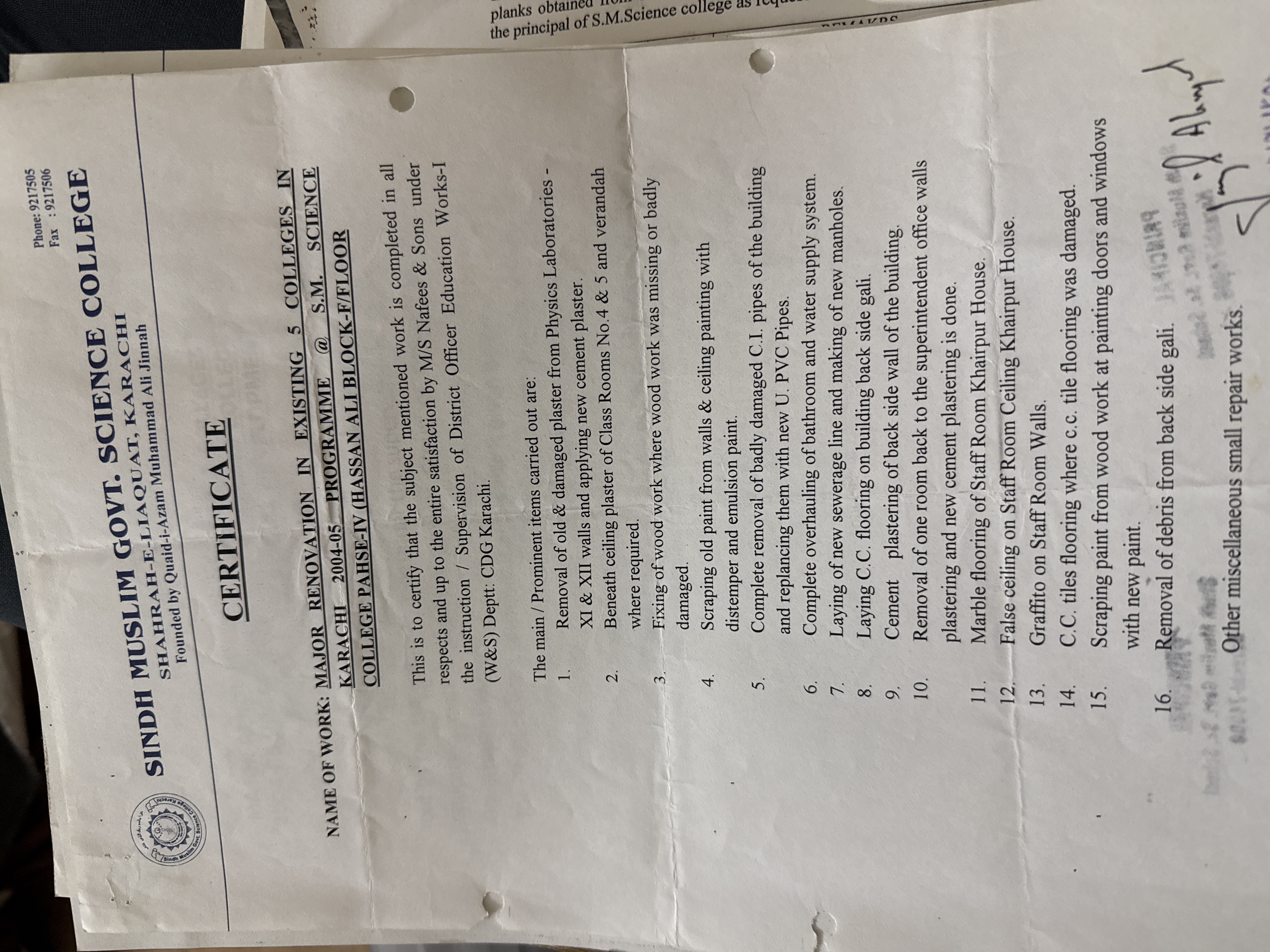 Completion certificate, Hassan Ali Block, F-Floor. Signed by the Principal, Sindh Muslim Government Science College, confirming full completion of F-Floor renovation works, Physics lab replastering, classroom ceilings, UPVC pipe replacement, sewerage line, bathroom overhaul, CC flooring, painting. Executed by M/S Nafees & Sons under supervision of D.O. Education Works-I (W&S) Deptt. CDG Karachi.
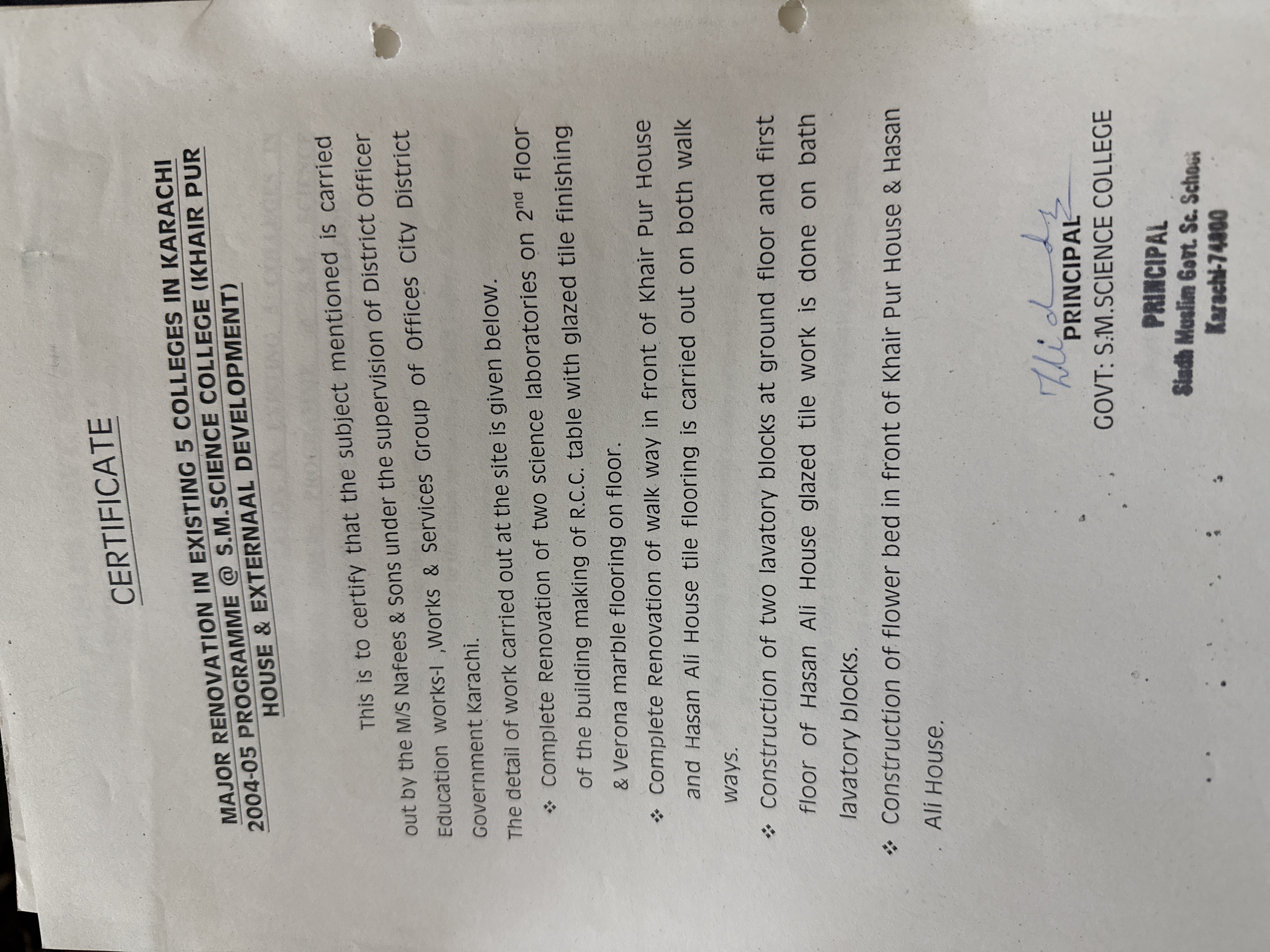 Completion certificate, Khairpur House & External Development. Signed by the Principal, Govt. S.M. Science College. Science laboratory complete renovation (RCC tables, glazed tile, Verona marble flooring), walkway tiling on both Khairpur and Hasan Ali frontages, lavatory blocks at two levels, and flower bed construction, all confirmed complete to specification.
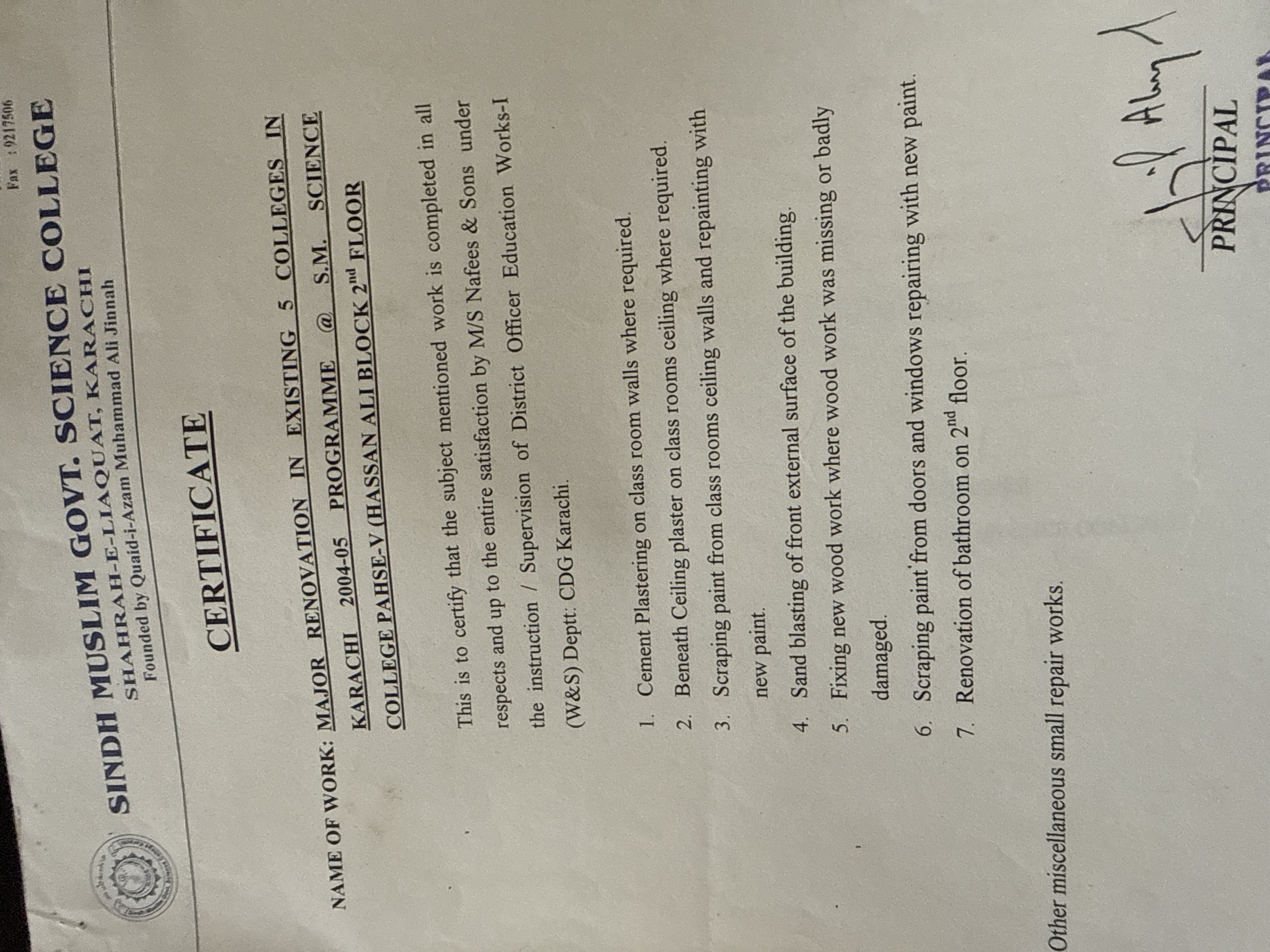 Completion certificate, Hassan Ali Block, 2nd Floor. Signed by Principal, Sindh Muslim Govt. Science College, Shahrah-e-Liaquat, Karachi. Cement plastering, beneath-ceiling plaster, scraping and repainting, sand blasting of front external surface, woodwork repair, door and window repainting, and bathroom renovation, all confirmed complete.
Six Years Later: The Certificate of Appreciation (2010)
In 2010, six years after the renovation programme concluded, Sindh Muslim Government Science College issued a formal Certificate of Appreciation to Naffees & Sons. Signed by Professor Zaibun Nisa Siddiuqi, Principal, it acknowledges the company's support, dedication, and commitment to the institution.
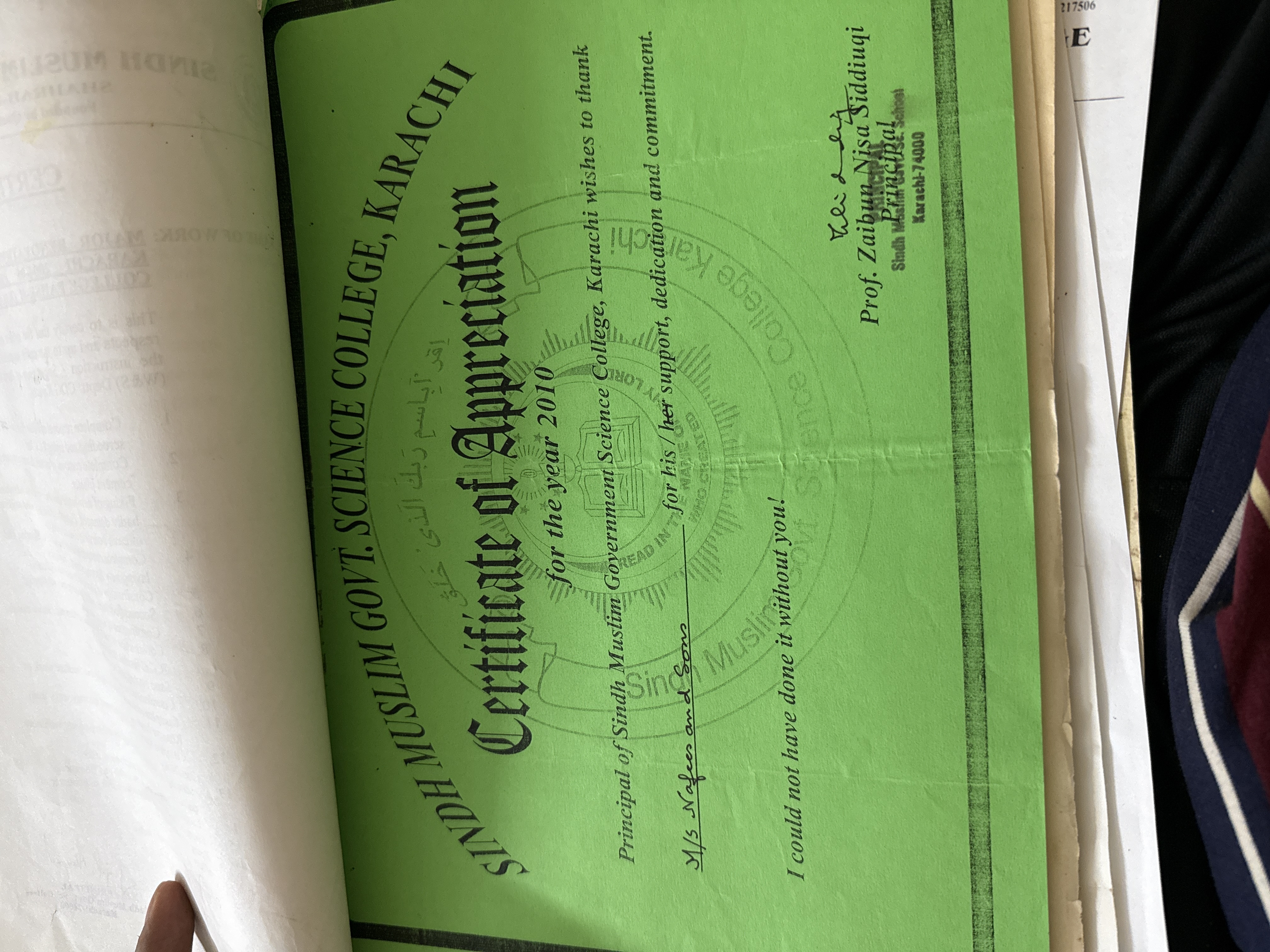 Certificate of Appreciation, year 2010. Signed by Prof. Zaibun Nisa Siddiuqi, Principal, Sindh Muslim Government Science College, Karachi. Issued to M/S Nafees and Sons in recognition of support, dedication, and commitment to the college.
A Certificate of Appreciation is not a routine sign-off. A college principal does not draft one, sign it, and issue it to a contractor six years after project completion as a formality. This kind of document gets issued when the work genuinely held up, when the professionalism was remembered, when something still looked and functioned the way it was supposed to, years after handover.
The renovation was completed in 2004–05. The certificate was issued in 2010. In those six years, the laboratories were in daily use. The walkways were walked every day. The plaster was on the walls. The pipes were carrying water. The bathrooms were functioning. And at the end of those six years, the Principal put her signature to a document saying Naffees & Sons deserved recognition for what they brought to this institution.
That is the closest thing to a performance review that exists in this industry.
What This Project Demonstrates About Naffees & Sons
This is a case study with documents. Not a marketing claim. Not a curated highlight reel. The government face sheets, the district approval letter, the three principal-signed completion certificates, and the 2010 Certificate of Appreciation are all reproduced above in full. Every figure, every signature, every date is verifiable by anyone who cares to look.
Approved government contractor status, earned, not assumed. The Composite Schedule of Rates framework used for these contracts requires firms to be formally registered with and approved by the Works & Services Department, Government of Sindh. Naffees & Sons was selected for a programme covering five of Karachi's major government colleges, not as one of several bidders on a single building, but as a qualified approved contractor on a multi-institution government initiative. That selection reflects a standing built over decades.
Rs.2.4 crore equivalent, twenty years ago. Rs.48,14,300 in 2004–05 was a substantial institutional contract by the standards of its time. At 2026 construction costs, approximately Rs.2.4 crore, it is a project that any contractor in Karachi would describe as significant. Naffees & Sons was delivering government contracts at this scale two decades ago. The scale of the firm's capability today reflects where that trajectory has led.
Variations handled correctly, every time. The Rs.21,300 revision on the Hassan Ali Block contract, from Rs.10,97,000 to Rs.11,18,300, was processed through the correct administrative channel, documented in a signed district government approval letter, and resolved without dispute. The number is small. What it shows is not. How a contractor handles small variations predicts how they will handle large ones: correctly, transparently, through the proper route.
Technical range across a complex institutional brief. The two contract phases covered structural plaster repair, full UPVC pipe replacement across an entire building, sewerage line construction, laboratory fit-out (RCC tables, Verona marble, glazed tile), walkway tiling, lavatory block construction, CC flooring, external facade sand blasting, painting and decoration. This is not one-trade work. It is broad-based institutional construction capability deployed across a multi-building brief.
Six years later, the Principal still remembered. The 2010 Certificate of Appreciation, issued half a decade after the project ended, by a college principal who had been living with the result of the work every day, is the most honest performance assessment that exists in this industry. The pipes were still carrying water. The plaster was still on the walls. The laboratories were still in use. And the college said thank you. Formally. In writing.
Government and Institutional Renovation in Karachi, A Record That Speaks
Naffees & Sons has been operating as a government-approved contractor in Karachi since 1972. The SM Government Science College contract is one project in a portfolio of institutional and government work spanning more than five decades, from shelterless school construction in Gadap to Rs.96 lakh model school conversions in Saddar, government schools, colleges, public offices, mosques, and civic infrastructure across the city.
The documentation on this project is complete. The contract values are on record. The certificates are signed. The appreciation was earned.
If you are responsible for a government institution, school, college, mosque, or civic building in Karachi that needs renovation, whether the scope is structural assessment, waterproofing, interior refurbishment, utility upgrade, laboratory fit-out, or a full multi-phase programme, Naffees & Sons has both the approvals and the track record to execute it. We will give you an honest assessment of the building and a clear, documented picture of what the work will cost.
For context on what government institutional contracts in Karachi actually involve, read our commercial construction guide. For a full contractor checklist, see our guide on how to choose a contractor in Karachi.
Contact us for a site visit and assessment →
Naffees & Sons | Karachi | Chat on WhatsApp