Govt. Girls Pilot Higher Secondary School Renovation, Nazimabad Karachi, Provincial Technical Sanction (2002)
Nazimabad No.1, Karachi — 2002
"Pilot" schools occupy a specific and deliberate position in Pakistan's government education system. They are not standard government schools. They are designated institutions, schools selected to operate to a higher standard, with better facilities, more rigorous teaching, and a stated purpose of demonstrating what government education is capable of when it is properly resourced and well run. In Karachi, the Pilot Higher Secondary Schools are among the most respected government institutions in their respective areas. Parents who want their daughters in a quality government school aim for the Pilot schools.
Government Girls Pilot Higher Secondary School No.1 in Nazimabad is exactly this. A flagship government girls' institution in one of Karachi's most established residential neighbourhoods, it serves students and families who have high expectations of a government school, because they chose it. When the building fabric of a school like this deteriorates to the point where it needs a formal repair programme, the government's response has to match the institution's standing.
In 2002, that response came in the form of a Rs.1.982 million five-school Technical Sanction approved at provincial government level, by the Project Director of Engineering Works Education Department and the Director of Education, Government of Sindh, with Govt. Girls Pilot Higher Secondary School, Nazimabad, allocated Rs.3,46,000 of that programme. Naffees & Sons was the contractor selected to execute the work. The Head Mistress of the school signed a detailed completion certificate listing nine categories of completed work, confirming satisfactory delivery under the supervision of District Officer Education Works-II, CDG Karachi.
This is the documented record of that project.
The Provincial Technical Sanction: Five Schools, Director Education, Govt. of Sindh
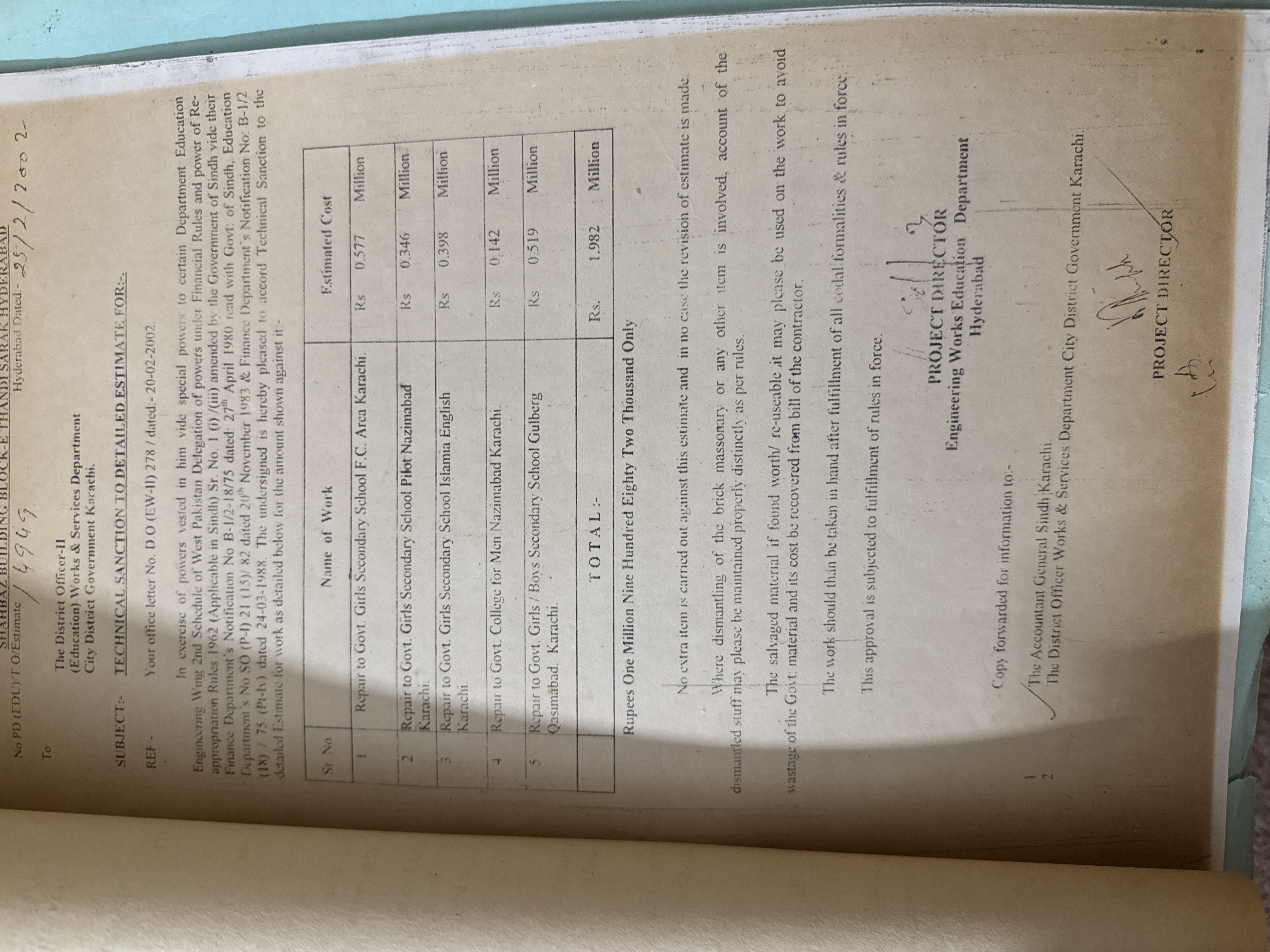
Technical Sanction from Engineering Wing, Works & Services Department (Education), dated 20-02-2002. Ref: Technical Sanction No. PD(EDU) TO Estimate No. D.O.(E.W.II) 278. Five schools, combined estimated cost Rs.1.982 million. Sanctioned by Project Director, Engineering Works Education Department, Hyderabad. Copies to: Accountant General Sindh, District Officer Works & Services CDG Karachi.
The Technical Sanction is the most senior document in this project file, and it is the document that places this contract in its proper context. This is not a single-school job approved by a district officer. It is a five-school repair programme, formally sanctioned at provincial government level by the Project Director of Engineering Works (Education Department) in Hyderabad.
The five schools included in the programme, with their allocated costs:
| Sr. | School | Estimated Cost |
|---|---|---|
| 1 | Govt. Girls Secondary School, F.C. Area, Karachi | Rs. 0.577 Million |
| 2 | Govt. Girls Secondary School, Pilot Nazimabad, Karachi | Rs. 0.346 Million |
| 3 | Govt. Girls Secondary School, Islamia English, Karachi | Rs. 0.398 Million |
| 4 | Govt. College for Men, Nazimabad, Karachi | Rs. 0.142 Million |
| 5 | Govt. Girls / Boys Secondary School, Gulberg Qasimabad, Karachi | Rs. 0.519 Million |
| TOTAL | Rs. 1.982 Million |
Combined sanctioned value: Rupees One Million Nine Hundred Eighty-Two Thousand (Rs.19.82 lakh).
At 2026 purchasing power, applying SBP CPI data showing approximately 5–6× inflation since 2002, this five-school programme represents approximately Rs.1 crore in today's money. The Pilot Nazimabad allocation of Rs.3,46,000 represents approximately Rs.17–19 lakh at 2026 prices.
The Authorising Chain: Provincial Government to Site
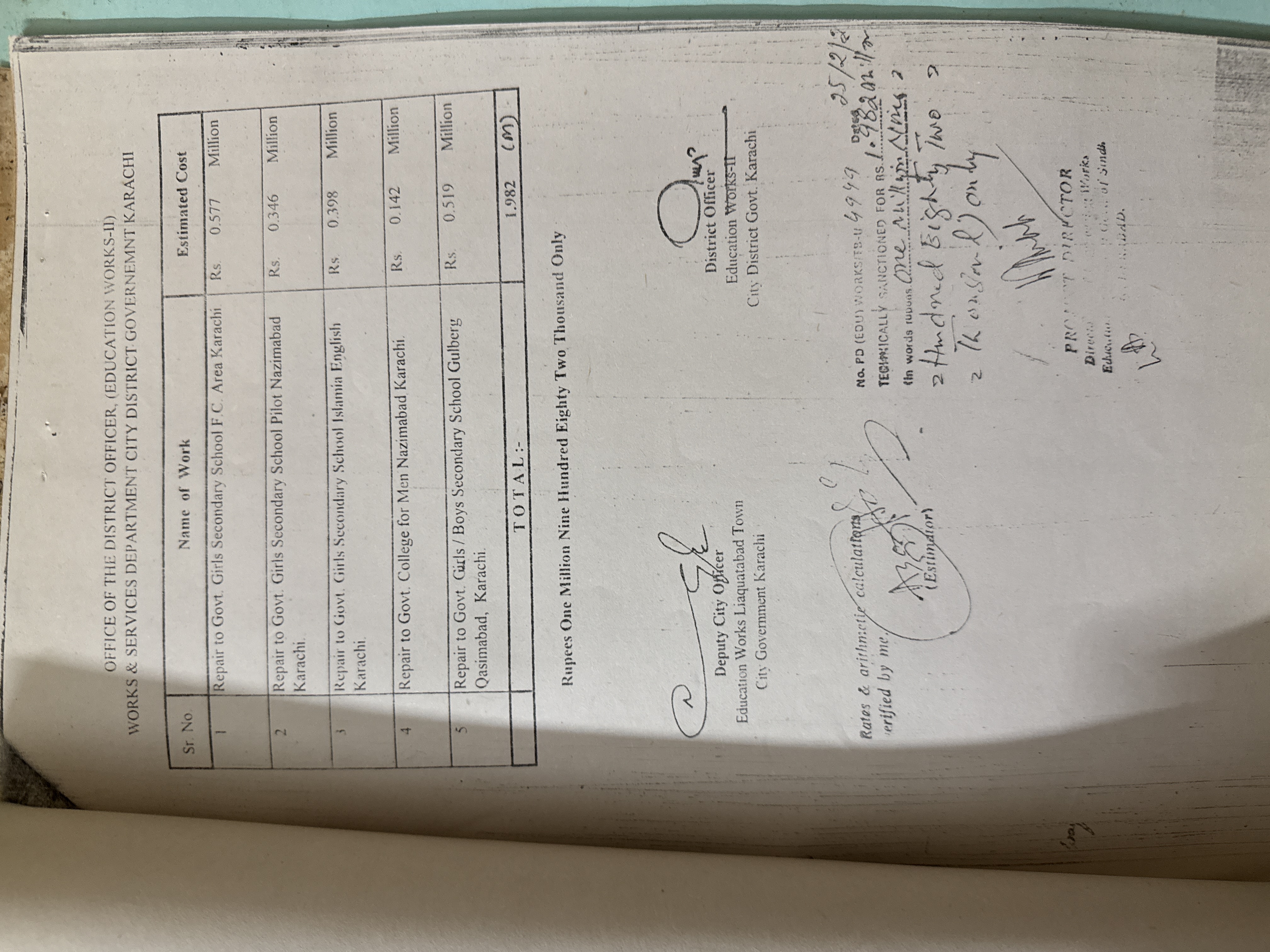
Technical Sanction continuation. Table of five schools (same allocation). Signed by: District Officer, Education Works-II, City District Govt., Karachi; Deputy City Officer, Education Works, Liaquatabad Town, City Government Karachi. Handwritten annotation: "Technically sanctioned for Rs.1,982,02/1/= Rupees One Million Nine Hundred Eighty Two Thousand Two Hundred Eighty Two Only." Countersigned by Project Director, Director Education, Govt. of Sindh.
The second Technical Sanction page carries the countersignatures that complete the authorising chain, and it is worth setting out exactly who signed what, because this chain is the definition of provincial-level government approval.
Authorising hierarchy for this sanction:
- Project Director, Engineering Works Education Department, Hyderabad, provincial-level engineering authority, responsible for the technical approval of the estimates and specifications
- Director of Education, Government of Sindh, the provincial Director of Education, whose countersignature on the Technical Sanction gives this programme its highest-level provincial sanction
- District Officer, Education Works-II, City District Government Karachi, the CDG Karachi authority overseeing implementation and contractor supervision
- Deputy City Officer, Education Works, Liaquatabad Town, City Government Karachi, the town-level supervising officer for contractor execution and stage sign-off
The handwritten notation on the document, "Technically sanctioned for Rs.1,982,02/1/= Rupees One Million Nine Hundred Eighty Two Thousand Two Hundred Eighty Two Only", is the formal administrative confirmation that the sanction was recorded and registered at the correct level.
This is what a provincially sanctioned government construction programme looks like from the inside. The Director of Education, Government of Sindh does not countersign routine municipal repairs. This was a programme with provincial government visibility and approval, administered downward through CDG Karachi's Works & Services apparatus to the contractor on site.
That contractor was Naffees & Sons.
The Work Order: District Officer Education Works-II, CDG Karachi
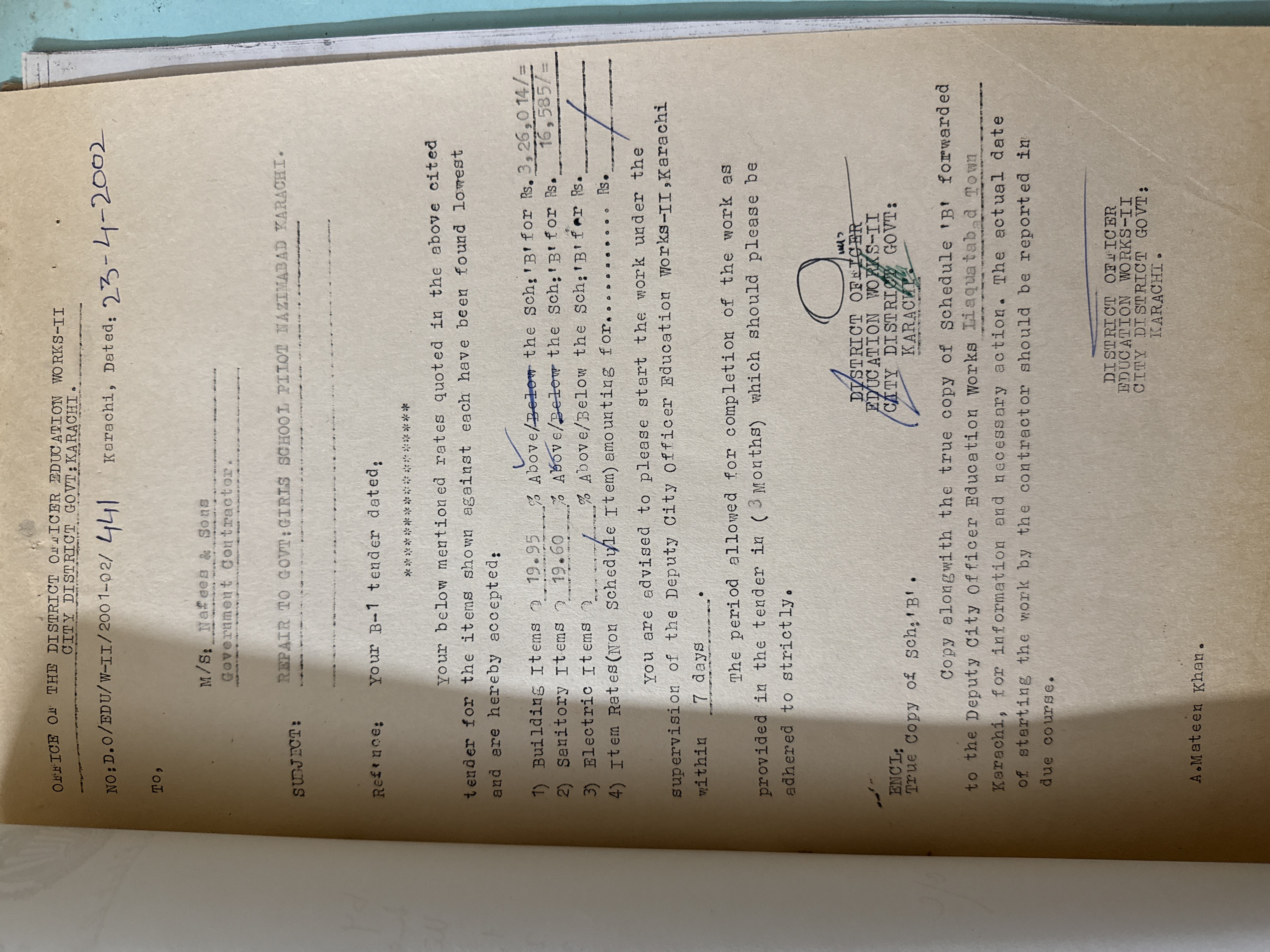
Work order Ref: NO.D.O./EDU/W-II/2001-02/441, dated 23-4-2002. Office of the District Officer Education Works-II, City District Government, Karachi. To: M/S Nafees & Sons, Government Contractor. Subject: Repair to Govt. Girls School Pilot Nazimabad Karachi. Building items at 19.95% above schedule, Rs.3,29,014. Non-schedule items Rs.12,535. Total approximately Rs.3,41,549. Period: 3 months. Supervision by Deputy City Officer, Education Works, Nazimabad Town. Signed by A. Mateen Khan, District Officer Education Works-II, CDG Karachi.
The formal work order for the Pilot Nazimabad school was issued by A. Mateen Khan, District Officer Education Works-II, CDG Karachi on April 23, 2002, two months after the Technical Sanction was signed. This sequence is standard in government contracting: Technical Sanction first (the provincial authority approves the programme and the estimated costs), then the formal work order issued to the contractor once the CDG-level procurement process is complete.
Contract details:
- Awarding officer: A. Mateen Khan, District Officer Education Works-II, CDG Karachi
- Supervising officer: Deputy City Officer, Education Works, Nazimabad Town
- Contractor: M/S Nafees & Sons, Government Contractor
- Building items: 19.95% above government schedule of rates, Rs.3,29,014
- Non-schedule items: Rs.12,535
- Total contract value: Approximately Rs.3,41,549
- Period allowed: 3 months (90 days)
- Start: Within 7 days of work order
- Supervision: Under Deputy City Officer, Education Works-II, Karachi
A rate of 19.95% above the schedule of rates requires explanation. The schedule of rates is the government's published reference for the cost of construction activities at a point in time. By 2002, construction material costs in Karachi, cement, steel, aggregate, bricks, had moved ahead of the schedule of rates, which are updated periodically but not continuously. A bid at 19.95% above schedule in 2002 reflects the actual market cost of construction at that time, tendered honestly against a benchmark that had not been fully updated to current prices.
The work order does not exist in isolation. It is the implementation document for a programme that was sanctioned at provincial level, approved by the Director of Education, Government of Sindh, and administered by CDG Karachi's Education Works-II division. Naffees & Sons received this work order because they were an approved government contractor, cleared the B-1 tender process, and submitted a bid the relevant authority found competitive and credible.
What Was Executed: Nine Categories of Work
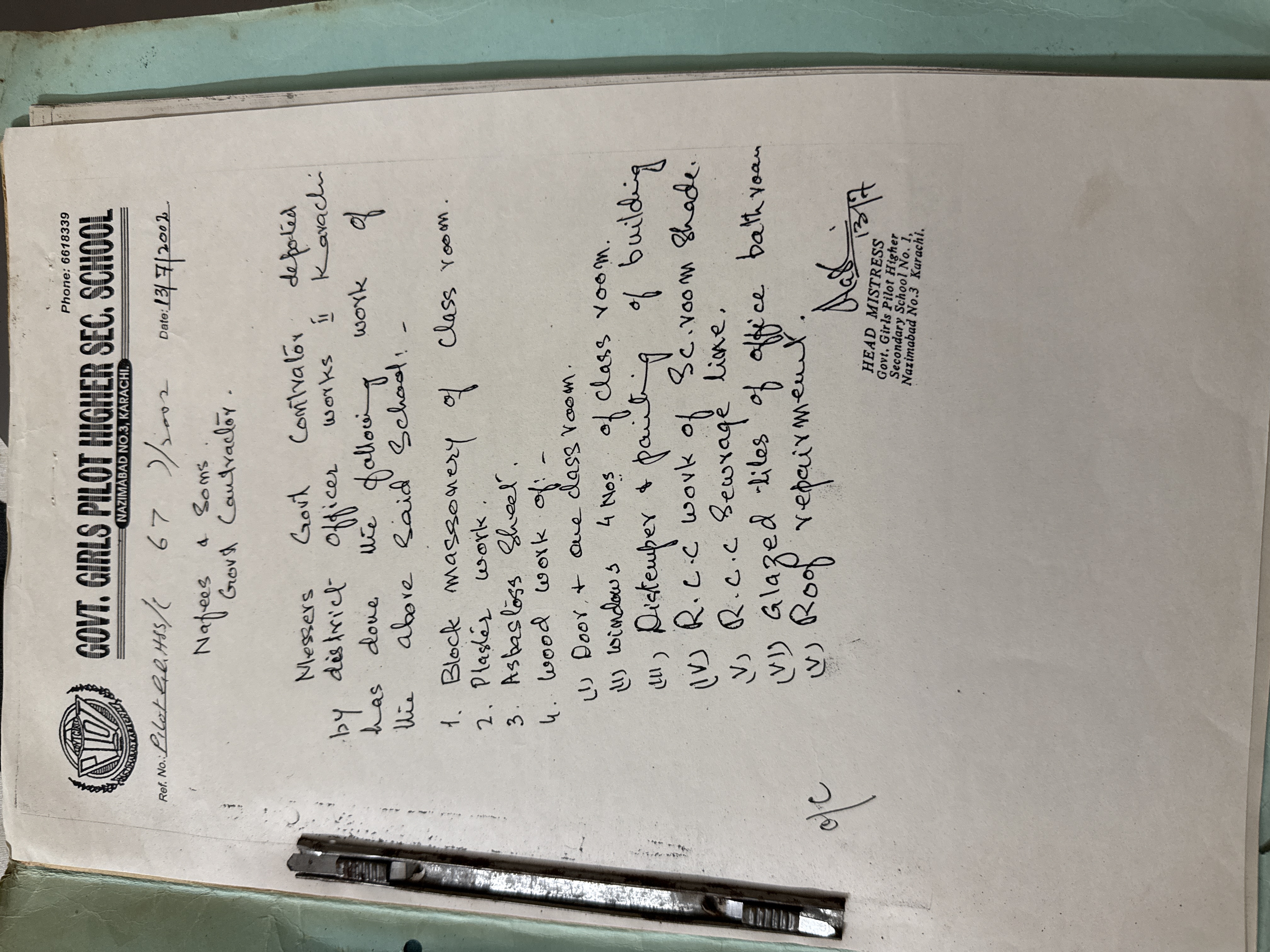
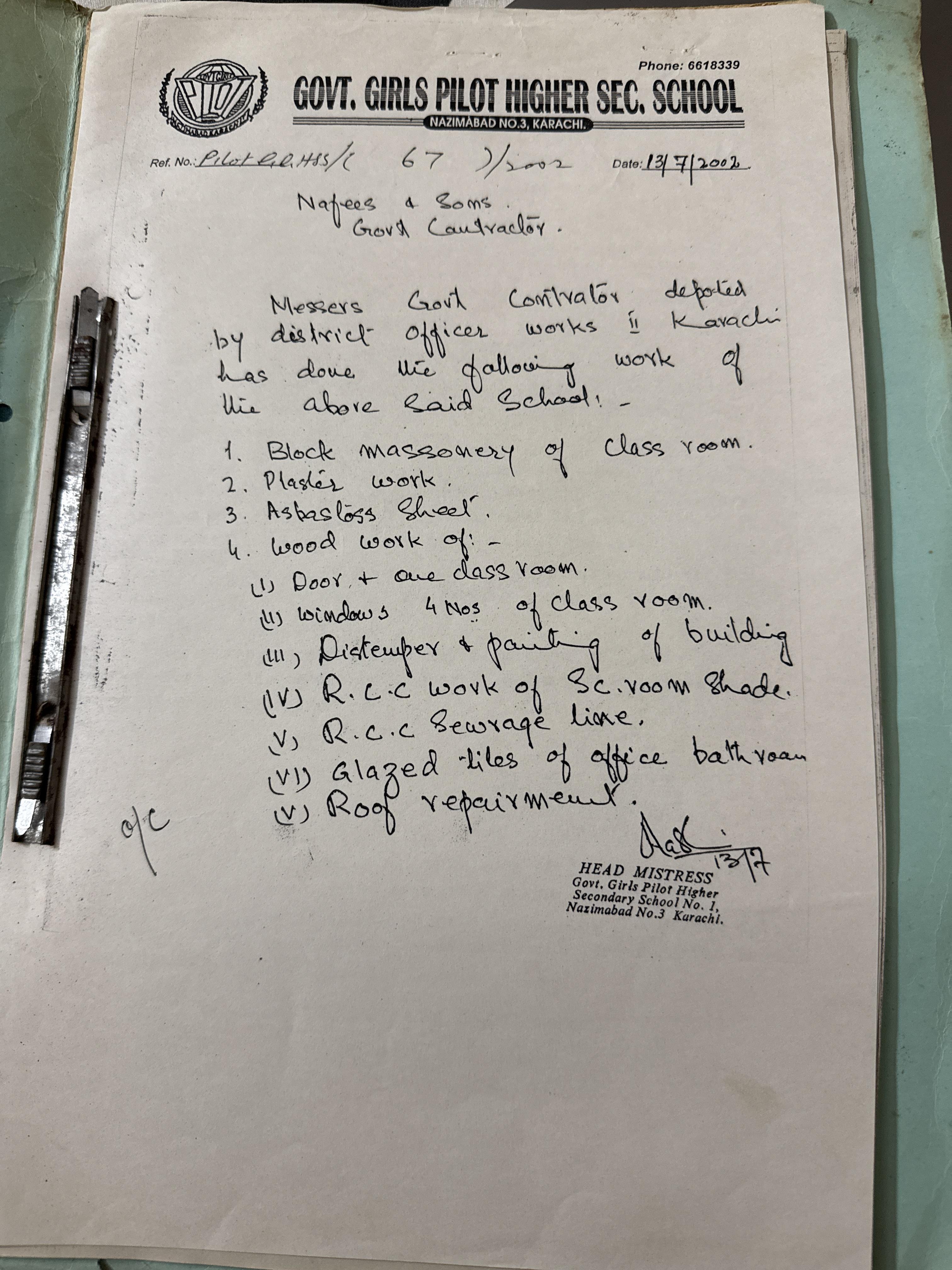
Certificate, Ref: Pilot 22/115/c, dated 12/7/2002. Official letterhead: Govt. Girls Pilot Higher Secondary School, Nazimabad No.1, Karachi. Signed by Head Mistress: "Messers Nafees & Sons, Govt. Contractor deputed by District Officer Works-II Karachi has done the following work of the above said School." Nine specific items listed. Dated 13th July 2002.
The Head Mistress of Govt. Girls Pilot Higher Secondary School, Nazimabad No.1, issued this completion certificate on July 12-13, 2002, approximately three months after the work order, consistent with the three-month contract period. What distinguishes this certificate from the others in Naffees & Sons' portfolio is its specificity: rather than a general statement of satisfactory completion, it lists nine distinct categories of completed work by name.
1. Block Masonry Work
Masonry using concrete blocks, the structural and infill wall work that forms the primary fabric of the construction scope. Block masonry at a government school in this context covers new construction or replacement of deteriorated wall sections, steps, plinths, and structural infill. Each course is set in cement mortar to the government specification; the finished work is the structural substrate for all subsequent finishes.
2. Plastic Work (Plaster)
Cement plaster applied to walls and ceilings, referred to in Karachi's construction vernacular as "plastic work." Plaster at a secondary school sees significant daily wear. At a building that had been running for years without a comprehensive renovation, the plaster surfaces would have accumulated cracks, hollow sections (where the plaster has detached from the substrate), and areas of moisture-induced deterioration. The correct approach, which is what government contractors are required to deliver, is to hack out all hollow and damaged sections, prepare the substrate, and apply new plaster in the proper sequence. Skimming over deteriorated plaster produces a result that fails within a season.
3. Asbestos Sheet
Asbestos cement sheeting was the standard roofing material for school compound structures, shades, and utility buildings in Pakistan through the mid-2000s. Its replacement or repair in 2002 addresses deteriorated roofing over school circulation areas or peripheral structures, ensuring waterproofing and structural integrity over areas where students and staff were daily present.
4. Wood Work, Door (1 Classroom) + Windows (4 Nos.)
Timber joinery: one classroom door and four classroom windows. In a government secondary school, classroom doors and windows are in continuous daily use, and in Karachi's humidity and temperature range, timber that is not properly maintained deteriorates over years of use. Warped door frames, swollen window shutters that do not close, broken glass panes, and deteriorated ironmongery all affect both the security and the thermal environment of the classroom. Replacing or repairing these elements is functional, not cosmetic.
5. Distemper and Painting of Building
The complete paint cycle across the building's internal and external surfaces. In the correct sequence: old paint scraped, surfaces made good, primer applied, distemper or emulsion applied in the specified coats. The visual transformation that paint produces is the most immediately visible result of a renovation, but the underlying preparation is what determines whether the paint adheres, how long it lasts, and whether it is covering a sound surface or simply concealing deterioration. On a supervised government contract, the Sub-Engineer checks the preparation before the paint goes on.
6. RCC Work, B.C. Room Shade
Reinforced cement concrete structural work for the B.C. (bicycle/cycle) room shade, the covered structure over the school's cycle storage area. A new or repaired RCC shade is a structural element: beams, columns, and slab, engineered to carry its own weight and the loads it bears, designed to last decades without significant maintenance. This is not a temporary or lightweight construction.
7. RCC Sewerage Line
New reinforced concrete sewerage line, the primary drainage infrastructure connecting the school's facilities to the external sewer. A sewerage line at a secondary school with a large daily student population has to be correctly graded, properly jointed, and sufficiently sized for the load. An inadequate sewerage line in a school becomes a sanitation problem within weeks of heavy use. The government specification for sewerage lines on school contracts is specific: pipe size, gradient, manholes, joint sealing, and backfill are all specified and inspected.
8. Glazed Tiles, Office Bathroom
Ceramic glazed tile work in the school's administrative office bathroom. Glazed tile is the correct specification for wet-area surfaces: impermeable, cleanable, durable, and resistant to the biological growth that affects untiled wet walls. Tiling an office bathroom to government specification means surface preparation, adhesive bed, tile layout set to level, properly grouted joints, a job that, done correctly, will remain serviceable for the life of the building.
9. Roof Repair
The roof of the main school building received repair works addressing whatever deterioration, cracking, or drainage issues had accumulated over the building's service life. Karachi's flat roofs are particularly vulnerable, the monsoon season delivers concentrated rainfall, the dry-season sun bakes the surface at temperatures that degrade waterproofing membranes, and the thermal cycling between the two conditions produces cracking at movement joints. Roof repair that works addresses the source of water ingress; roof repair that does not work simply delays the next failure.
The Completion Certificate: What the Head Mistress Recorded
The Head Mistress of Govt. Girls Pilot Higher Secondary School, Nazimabad No.1, issued this certificate on the school's official letterhead, with the school's stamp, in July 2002. She named the contractor (Naffees & Sons), named the authority that deputed them (District Officer Works-II), and listed nine specific categories of work.
A Head Mistress of a Pilot school, the principal of one of Karachi's designated premium government institutions, does not issue this kind of certificate as a formality. She writes it when she has seen the work, assessed it against the standard her institution requires, and is satisfied that what was delivered is what was promised.
Nine items. Every one of them confirmed complete. The certificate exists.
The Challenges: A Flagship School, a Demanding Standard
1. The Pilot School Standard
A Pilot school carries expectations that a standard government school does not. Its students are there specifically because their families wanted the higher-standard government institution. The Head Mistress is accountable to a parent body with elevated expectations. Renovation work at a Pilot school that produces visually inferior results, patchy plaster, paint applied over inadequate preparation, woodwork that does not close correctly, will be noticed and commented upon by the very community that chose the school for its quality.
Naffees & Sons' track record on government school contracts was built on delivering to the government specification, every time. At Pilot Nazimabad, that standard was especially visible, because the people who would see the result cared most about it.
2. Managing Nine Concurrent Work Streams
Nine distinct categories of work, masonry, plaster, asbestos sheet, carpentry, painting, RCC shade, RCC sewerage, tiling, and roof repair, running simultaneously on a single school campus require trade sequencing, materials management, and site organisation that a single-trade operator cannot deliver. The structural and masonry work must be complete before plastering begins. The plaster must be cured before painting. The RCC elements must be formed, poured, and stripped in sequence. The sewerage line must be laid, graded, and inspected before backfilling.
Managing this sequencing correctly, within a three-month contract period, on a functioning school campus, required embedded site management from a contractor with genuine multi-trade capability.
3. Working Under Provincial-Level Scrutiny
When the Director of Education, Government of Sindh, countersigns a Technical Sanction, the programme has visibility at a level that most school-level contracts do not reach. The Deputy City Officer's site supervision on this contract was not routine, it was supervision within a programme that was being monitored upward through CDG Karachi to the provincial education directorate. A contractor who cuts corners on a provincially sanctioned programme creates an administrative problem that reaches well above the CDG level.
Naffees & Sons executed to specification. The completion certificate confirms it.
4. Three-Month Programme in an Occupied School
The contract period was 90 days. The school was in operation. Nine categories of construction work, structural, mechanical, finishing, had to be completed within that window, around the school's academic schedule, without disrupting the Pilot school's functioning. This required front-loading the noisy and disruptive trades (masonry, RCC, sewerage) into the first month, managing plaster and painting through the middle period, and completing the precision finishes (tiles, carpentry, painting) in the final phase while the school was in full use.
5. The Technical Discipline of a Five-School Programme
Naffees & Sons' execution at Pilot Nazimabad was not the only work in progress on this Technical Sanction. The Rs.1.982 million programme covered four other schools simultaneously, F.C. Area, Islamia English, Gulberg Qasimabad, and Govt. College for Men, Nazimabad. Resources, supervision, and materials had to be allocated across multiple sites. The Pilot Nazimabad contract (Rs.3,41,549) ran alongside the larger F.C. Area contract (Rs.577,000) and the Gulberg Qasimabad contract (Rs.519,000). Programme-scale contracting requires a contractor with the organisational capacity to manage multiple sites under the same Technical Sanction without letting any single contract suffer for the demands of the others.
What This Contract Demonstrates
| Document | What It Confirms |
|---|---|
| Technical Sanction (Project Director + Director Education, Govt. of Sindh) | Provincial-level sanction; five-school programme; Rs.1.982M combined; Naffees & Sons as executing contractor for Pilot Nazimabad |
| Technical Sanction continuation (D.O. + DCO signatures) | CDG Karachi endorsement; programme registered and sanctioned administratively |
| Work order (A. Mateen Khan, D.O. Education Works-II, 23-4-2002) | Formal contract award; Rs.3,41,549; 19.95% above schedule; 3-month period |
| Head Mistress completion certificate (12/7/2002) | Nine specific work items confirmed complete; Head Mistress of Pilot school satisfied |
Four documents. A complete chain from provincial government Technical Sanction to District Officer work order to Head Mistress satisfaction certificate. This is government contracting at its most fully documented.
Contract Value in Today's Money
Rs.3,41,549 in 2002 represents approximately Rs.17–19 lakh at 2026 prices (5–6× SBP CPI inflation since 2002).
The five-school programme total of Rs.1.982 million, Rs.19.82 lakh, represents approximately Rs.1 crore at 2026 prices.
Being one of the contractors executing a programme of this scale, at a provincially sanctioned level, covering five schools in North Karachi and Nazimabad simultaneously, is a statement of capability that is independent of any single contract value.
Part of a Larger Portfolio
The Pilot Nazimabad renovation sits alongside a portfolio that spans government school construction from the early 2000s through 2012:
- GPS Abdul Ghaffar, Gadap Town (2002–03), Two-classroom shelterless school; remote site; Works & Services Dept ADP contract
- Qasba Colony Primary to Middle School Upgradation (1998–2003), Rs.35.6 lakh PC-I; five-year programme; Rs.2.19 lakh saving to government
- President's Education Sector Reform Programme (2001–06), Multi-package toilet facility rehabilitation; two independent Head Mistress certificates; CDG Karachi
- SM Government Science College, Saddar (2004–05), Rs.48 lakh two-phase renovation; Certificate of Appreciation 2010
- P&T Colony Model School Conversion (2007–12), Rs.96 lakh; four work orders; five-year programme
The Government Girls Pilot Higher Secondary School, Nazimabad, is the most prestigious school on this list, a designated flagship government institution, carrying a provincial-level Technical Sanction, in one of Karachi's established residential areas. The Head Mistress saw the work and confirmed it. The Director Education, Government of Sindh, sanctioned it. That is the highest level of government endorsement in this portfolio.
Renovating Government Schools in Karachi: The Contractor That Earns Provincial Standing
Naffees & Sons has been executing government school and institutional contracts in Karachi since 1972. The documents in this portfolio, spanning shelterless school construction in remote Gadap to Pilot school renovation in Nazimabad, covering everything from compound walls to provincially sanctioned multi-school programmes, tell a consistent story. Government departments at every level, from Deputy City Officer to Director of Education, Government of Sindh, have trusted this firm to build and repair public education infrastructure in Karachi.
That standing is earned project by project, certificate by certificate, over more than five decades.
If you are responsible for a school, college, or institutional building requiring construction, renovation, or repair, under any government programme or on a privately commissioned basis, Naffees & Sons has the approvals, the track record, and the site management capability to deliver it.
Contact us for a project assessment →
Naffees & Sons | B-142, Block A, North Nazimabad, Karachi | Chat on WhatsApp
Related Projects
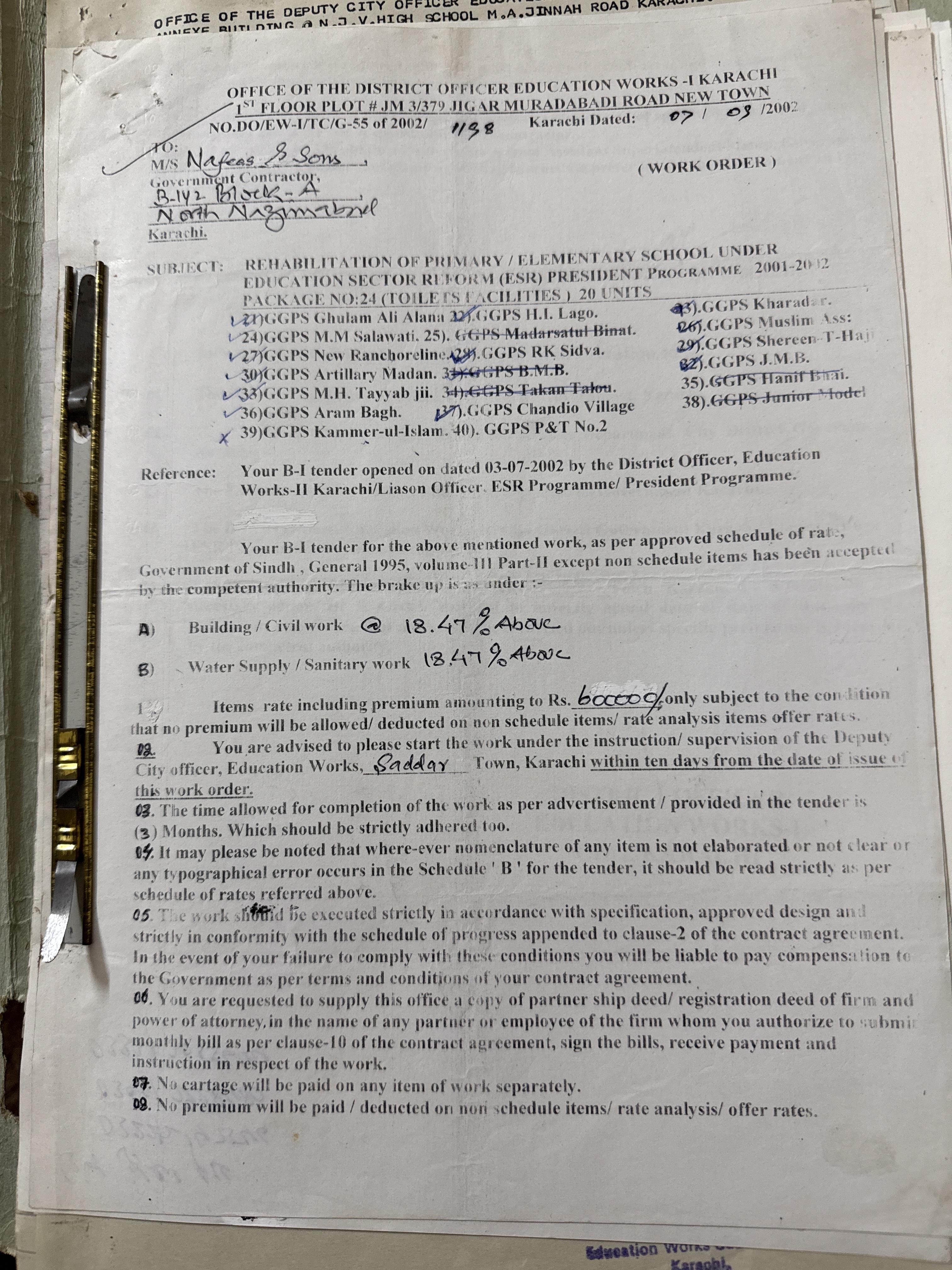
President's Education Sector Reform Programme, Multi-School Toilet Rehabilitation, Karachi (2001–06)
Saddar Town, Karachi — 2001
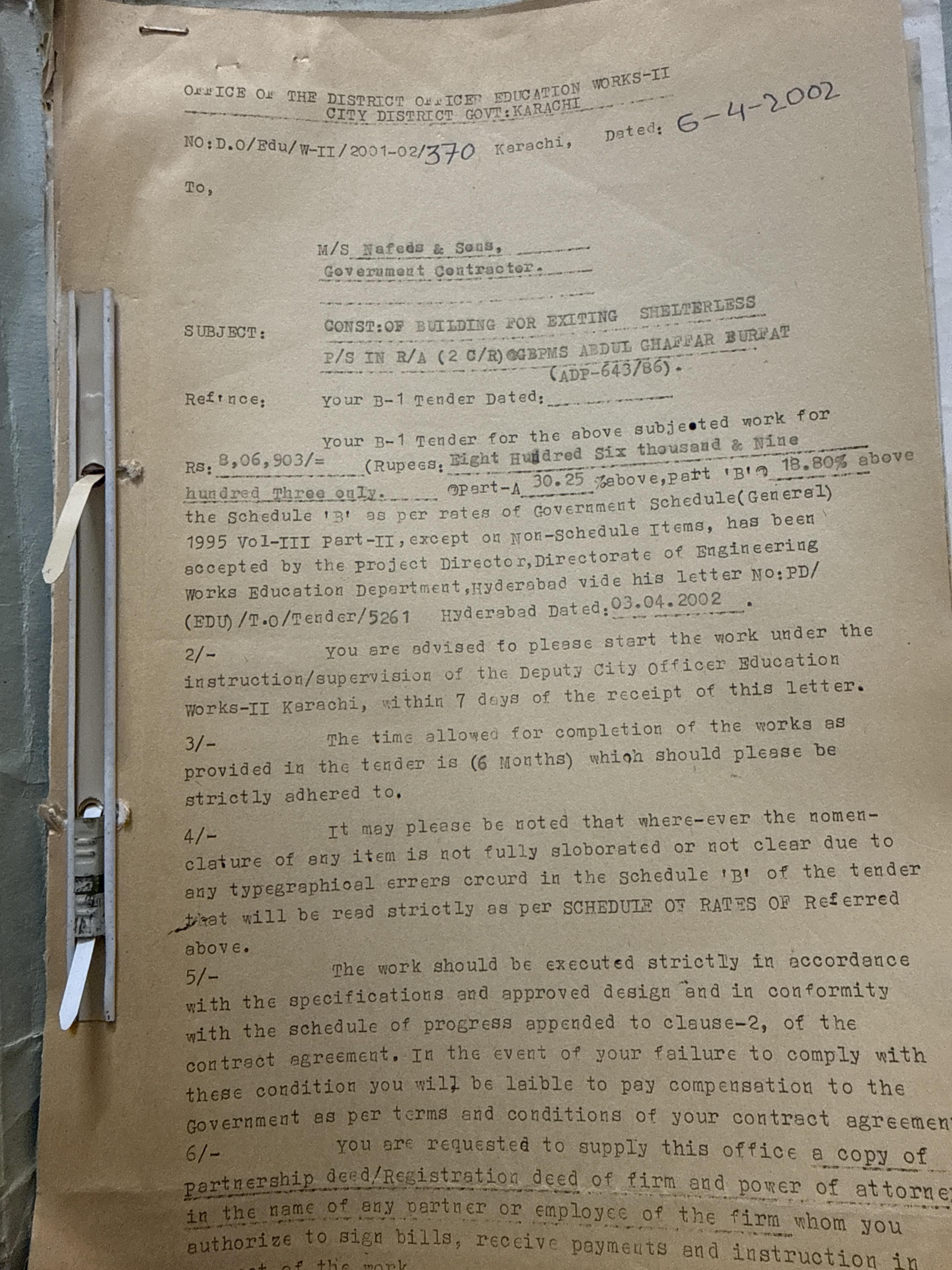
GPS Abdul Ghaffar Shelterless School, Two-Classroom Construction, Gadap, Karachi (2002–03)
Burpat, Gadap Town, Karachi — 2002
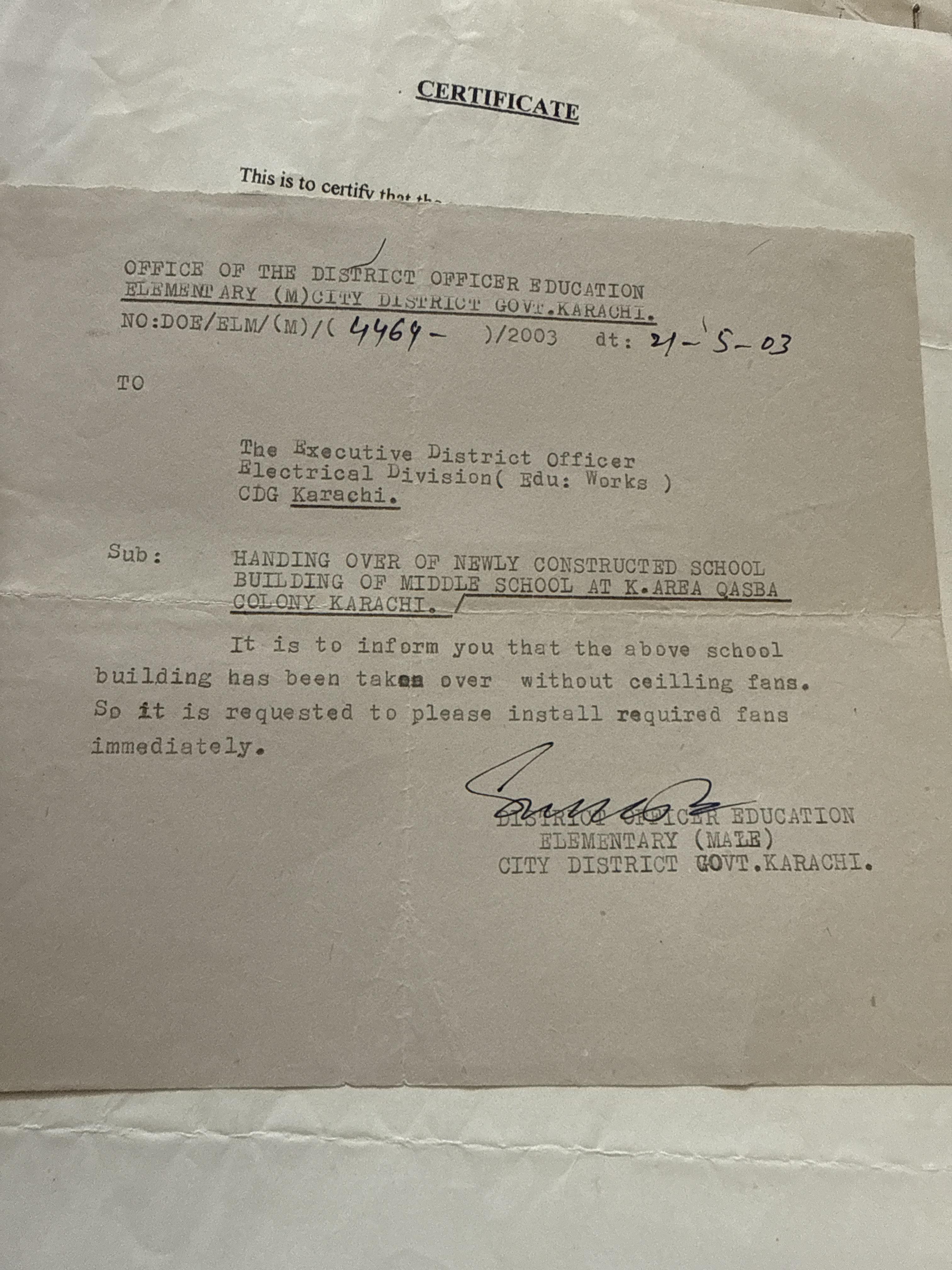
Primary to Middle School Upgradation, K Area, Qasba Colony, Karachi (1998–2003)
K Area, Qasba Colony, Orangi Town, Karachi — 2003