Primary to Middle School Upgradation, K Area, Qasba Colony, Karachi (1998–2003)
K Area, Qasba Colony, Orangi Town, Karachi — 2003
Upgrading a functioning government school, taking it from primary level to middle school, is not simply a matter of adding more classrooms. It is a transformation of the institution's physical infrastructure, its service capacity, and its role in the community. More students, older children, a longer school day, an expanded curriculum, new laboratory and sanitary requirements. The building has to support all of it.
The project Naffees & Sons executed at K Area, Qasba Colony, Karachi from 1998 to 2003 was exactly this. A government primary school serving one of Karachi's most densely populated neighbourhoods, Qasba Colony in Orangi Town, required full upgradation to middle school standard under the Annual Development Programme (ADP), commissioned by the Works & Services Department, City District Government Karachi. The work ran for five years, was completed in all respects, and was handed over formally to the District Officer Education (Male), CDG Karachi in May 2003.
The PC-I sanctioned cost was Rs.35,61,514. The actual cost delivered was Rs.33,42,174, a net saving of Rs.2,19,340 returned to the government exchequer.
This is the documented record of that project.
The Contract: ADP, Works & Services Department, CDG Karachi
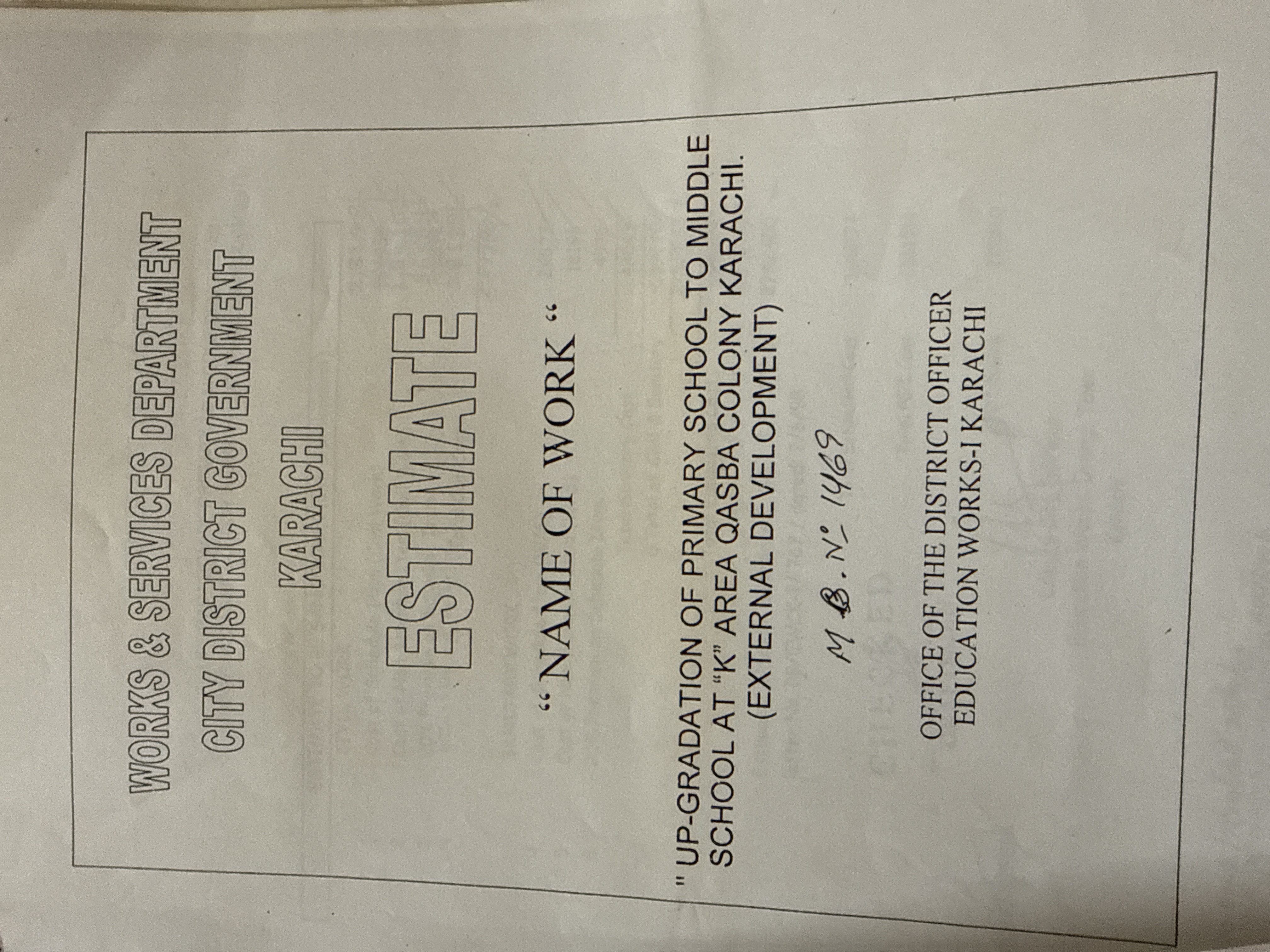
Government estimate cover: Upgradation of Primary School to Middle School at "K" Area, Qasba Colony, Karachi (External Development), Works & Services Department, City District Government Karachi, Office of the District Officer Education Works-I Karachi. M.B. No. 1469.
The project was commissioned under the Annual Development Programme (ADP), Pakistan's formal capital expenditure mechanism for public infrastructure. ADP contracts require multi-stage government approval: budget line allocation, PC-I sanction from the planning authority, technical approval from the relevant departmental officer, and formal work order issuance before construction can begin. This is not a loosely procured job. Every stage, from estimate to completion, is on paper and on record.
Awarding authority: Works & Services Department, City District Government Karachi
Executing division: Office of the District Officer Education Works-I, Karachi
Supervising officer: Deputy City Officer (Education Works), Orangi Town
Receiving authority at handover: Shaikh Shamim Ahmed, District Officer Education (Male), CDG Karachi
Contractor: M/S Nafees & Sons (Naffees & Sons)
Estimate sanctioned: June 2, 1998 (S.E. Office letter No. PB/EWCK-1/767)
Project completed and handed over: May 21, 2003
Programme duration: Approximately five years
At 2026 purchasing power, applying Pakistan's SBP CPI data showing approximately 6–7× inflation since 1998, the PC-I sanctioned value of Rs.35,61,514 represents approximately Rs.2.1 crore in today's money. The actual cost of Rs.33,42,174 represents approximately Rs.2 crore.
The School and the Community It Serves
Qasba Colony is one of Karachi's most densely populated urban areas, situated in Orangi Town, a zone that grew rapidly through the 1970s and 1980s as the city expanded westward along the National Highway corridor. By the late 1990s, the area's government schools were serving communities with significant unmet demand for education beyond primary level.
A primary school that stopped at Grade 5 was, for many families in K Area, the end of the educational road, not because middle school did not exist elsewhere in Karachi, but because the practical reality of commuting across a city of fifteen million people for a child in Grade 6 was a barrier most working families simply could not overcome. The nearest middle school might be forty-five minutes away by bus. For a family where both parents work irregular hours and there is no reliable transport, that distance is not navigable.
The government's ADP allocation to upgrade this school from primary to middle school was a direct response to that demand. It was also a recognition that the school's physical infrastructure, sized and specified for primary-age children, needed to be comprehensively re-built to serve the additional years of education now being offered. You cannot simply relabel a primary school as a middle school and open the gates. The building has to change.
For the families of K Area, Qasba Colony, the completion of this project in 2003 meant their children could continue education through Grade 8 without leaving the neighbourhood. For Naffees & Sons, it meant building something with a direct and legible impact on a community, which is the most straightforward definition of meaningful construction work.
Financial Documentation
Abstract of Cost
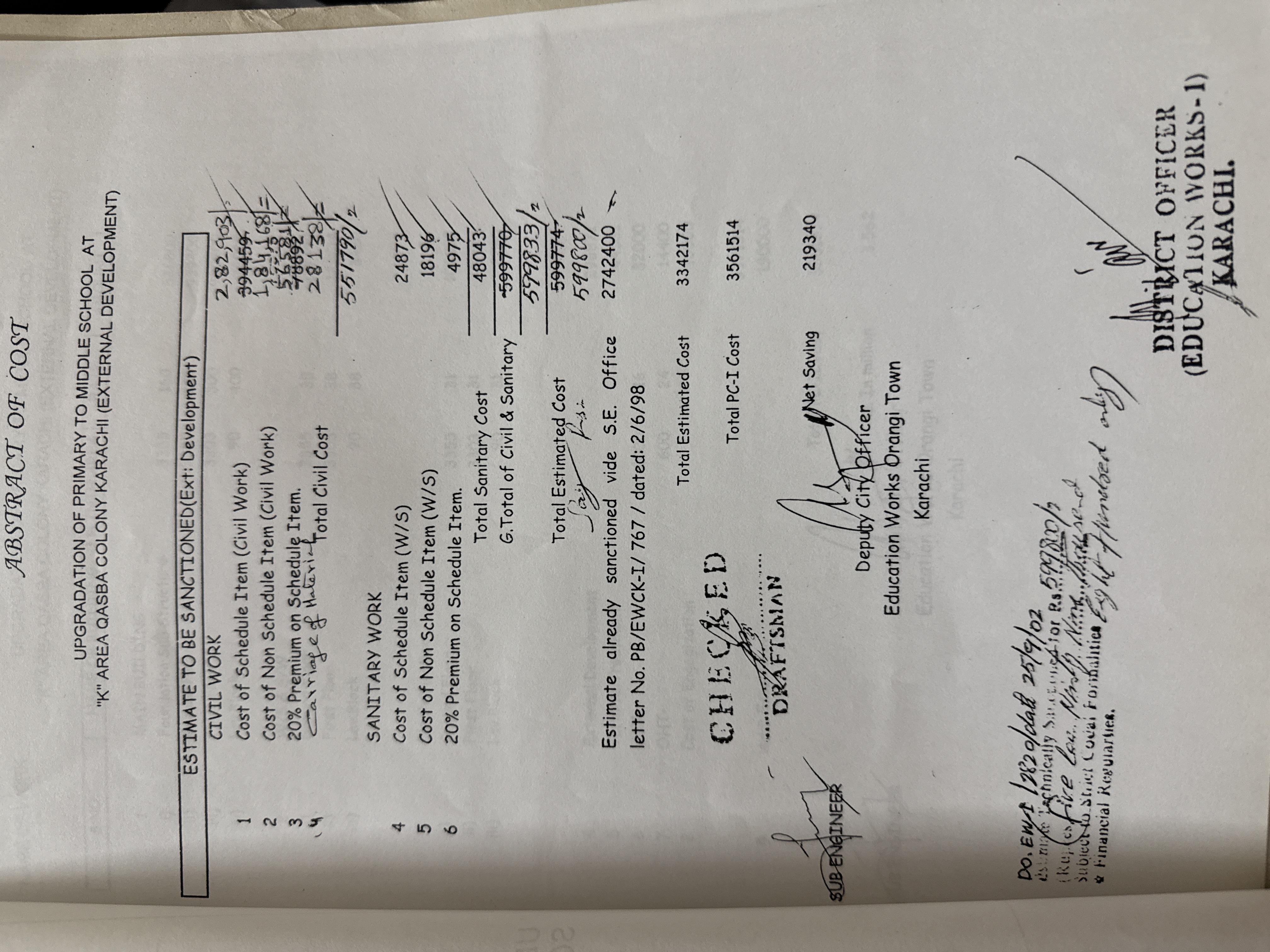
Abstract of cost: Upgradation of Primary to Middle School, "K" Area Qasba Colony, Karachi (External Development). Civil and Sanitary breakdown, PC-I sanctioned value, total estimated cost, net saving. Checked by Sub Engineer; signed by District Officer (Education Works-I), Karachi.
The government's Abstract of Cost is the formal financial summary of the project, not a contractor's invoice, but the Works & Services Department's own certified breakdown, signed by the District Officer (Education Works-I) and checked by the Sub Engineer. It provides the itemised split across civil and sanitary works, the approved PC-I sanction, the total estimated cost at completion, and the net saving.
| Cost Category | Amount (Rs.) |
|---|---|
| Civil Work, Schedule Items | 2,82,903 |
| Civil Work, Non-Schedule Items | 3,94,459 |
| Civil Work, Premium | Included |
| Total Civil Cost | 5,51,790 |
| Sanitary, Schedule Items (W/S) | 24,873 |
| Sanitary, Non-Schedule Items (W/S) | 18,196 |
| Sanitary, Premium | 4,975 |
| Total Sanitary Cost | 48,043 |
| Grand Total (Civil + Sanitary) | 5,99,833 |
| Total Estimated Cost (Final) | Rs.33,42,174 |
| PC-I Sanctioned Cost | Rs.35,61,514 |
| Net Saving to Government | Rs.2,19,340 |
The net saving is Rs.2,19,340. On a multi-year government contract, in a high-density urban location, across civil and sanitary works, bringing the project in under the PC-I sanctioned amount is not accidental. It reflects accurate initial tendering, disciplined materials management, and the kind of site management that avoids wastage and rework. That saving is returned to the government exchequer. It is the most objective measure in this record of how well the contract was managed.
Detailed Bill of Quantities
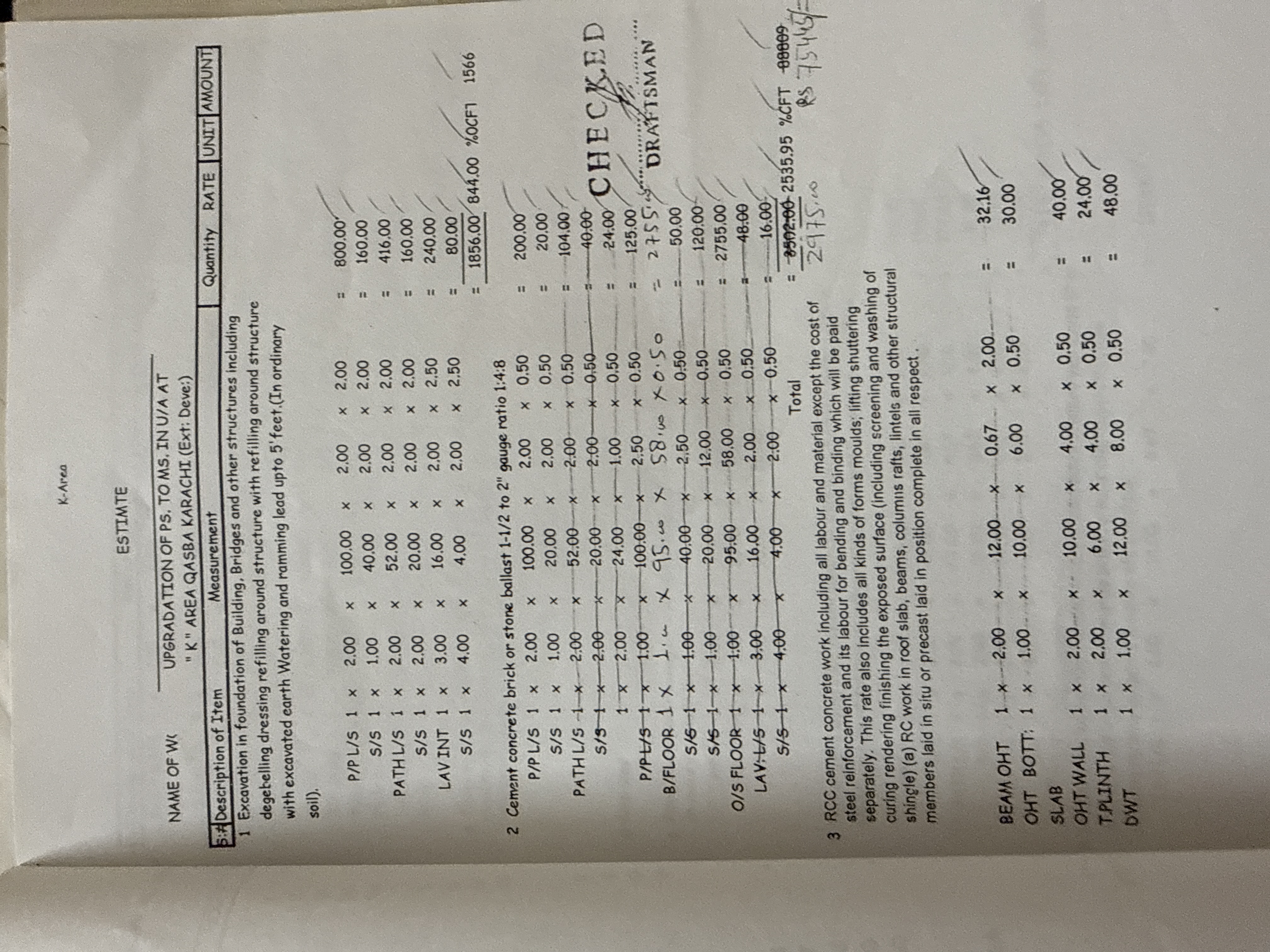
Detailed bill of quantities: external development works for upgradation at K Area, Qasba Colony, Karachi. Itemised measurement calculations for excavation, foundation concrete, RCC work, OHT (overhead tank) structure, slab, T-plinth, DWT. Checked by Draftsman, Education Works-I.
The detailed estimate sheet carries the full itemised measurement calculations for the external development scope. This is the technical document that underpins both the cost certification and the works programme, every element measured, rated, and checked before a rupee was spent. Key elements confirmed in the bill of quantities:
- Excavation in foundation, Building, bridges, and other structures; degebelling, dressing, and refilling around structures with ramming; lead to 5 feet depth
- Cement concrete, Stone ballast 1½" to 2" gauge, ratio 1:4:8, for sub-base and foundation works
- RCC work, All labour and material, steel reinforcement, all forms and moulds, lifting, shuttering, curing, rendering to exposed surfaces including columns, rafts, lintels, and structural members
- Structural elements: Beam (OHT), OHT bottom, Slab, OHT walls, T-Plinth, DWT (drainage/waste tank)
Each line item carries full measurement breakdowns, dimensions, quantities, rates, and amounts, checked and countersigned by the government draftsman. This is what "properly documented construction" looks like from the government side.
Scope of Work: What Upgrading to Middle School Required
Upgrading a primary school to middle school is a substantially more complex construction exercise than it might initially appear. It is not simply adding classrooms. The physical requirements of a middle school differ from a primary school in specific, consequential ways, and the Works & Services Department specification accounts for all of them.
New Classroom Block Construction
Middle school in Pakistan's government system serves Grades 6, 7, and 8, students who are older, physically larger, present in greater numbers, and generating higher infrastructure load than the primary years the school was originally designed for. The existing primary building needed additional classroom capacity, and those classrooms had to be built to the government specification: reinforced concrete structure, brick masonry infill walls, specified window and door openings sized for natural light and cross ventilation, internal cement plaster finish, and durable flooring appropriate for institutional use.
This was not a lightweight extension job. It was structural construction, foundations, columns, beams, slabs, brickwork, plaster, executed to the Works & Services Department standard and inspected at each stage by the government Sub Engineer before the next stage could proceed.
Overhead Water Tank (OHT)
The bill of quantities specifically identifies the OHT structure, beam, slab, walls, and base, as a major works item. This is not incidental.
A middle school has a substantially larger daily population than a primary school. Ablution facilities, bathrooms, and water points for students and staff across a full school day require reliable water pressure. In Qasba Colony, as in most of Karachi's older urban areas, municipal water supply pressure is insufficient to deliver water to upper floors without an overhead tank. The OHT provides gravity-fed pressure to the entire building's water system.
The structural design of an OHT is not trivial, it is a loaded structure that must be engineered for the weight of a full water tank (one litre of water weighs one kilogram; a standard school OHT holds several thousand litres). The RCC beam-and-slab construction shown in the bill of quantities is the correct approach for this load. It was built to the government engineering specification and will outlast the rest of the building if maintained correctly.
Drainage and Sanitary Infrastructure
The DWT (drainage/waste tank) and associated sanitary line construction appear as specific items in the bill of quantities. Sanitary infrastructure is one of the most consequential, and most frequently deferred, elements of government school construction. An undersized or poorly designed drainage system in a high-occupancy school becomes a health and hygiene problem within the first monsoon season after opening.
The sanitary component of the estimate, Rs.48,043, covered water supply and drainage pipework, WC suite installations, washbasin units, and drainage connections sized for the school's new middle school population. In government contracts, every fitting is specified against Works & Services Department schedule rates and measured by the Sub Engineer. There is no informal variation in a sanitary scope on an ADP contract.
External Development and Circulation
Circulation between buildings, paved paths within the school compound, and the external perimeter works formed a significant element of the external development scope. A middle school's campus does not function well if the spaces between buildings are unfinished, poorly drained, or unsafe underfoot. Properly surfaced and graded circulation routes, built to the specification and with the drainage detailing that keeps them functional through Karachi's monsoon months, are a functional requirement, not an aesthetic choice.
Plinth and Foundation Works
The T-plinth and foundation works visible in the bill of quantities represent the substructure of the new constructions. Plinth construction, the portion of the structure between the foundation and the ground floor level, establishes the building's resistance to rising moisture. A properly constructed T-plinth with DPC (damp proof course) is what prevents the waterproofing failures that affect so many of Karachi's older institutional buildings. This is the work that is never seen after the building is finished; it is also the work that determines how long the building remains serviceable.
The Handover: Formal Completion and Government Sign-Off
Completion Certificate
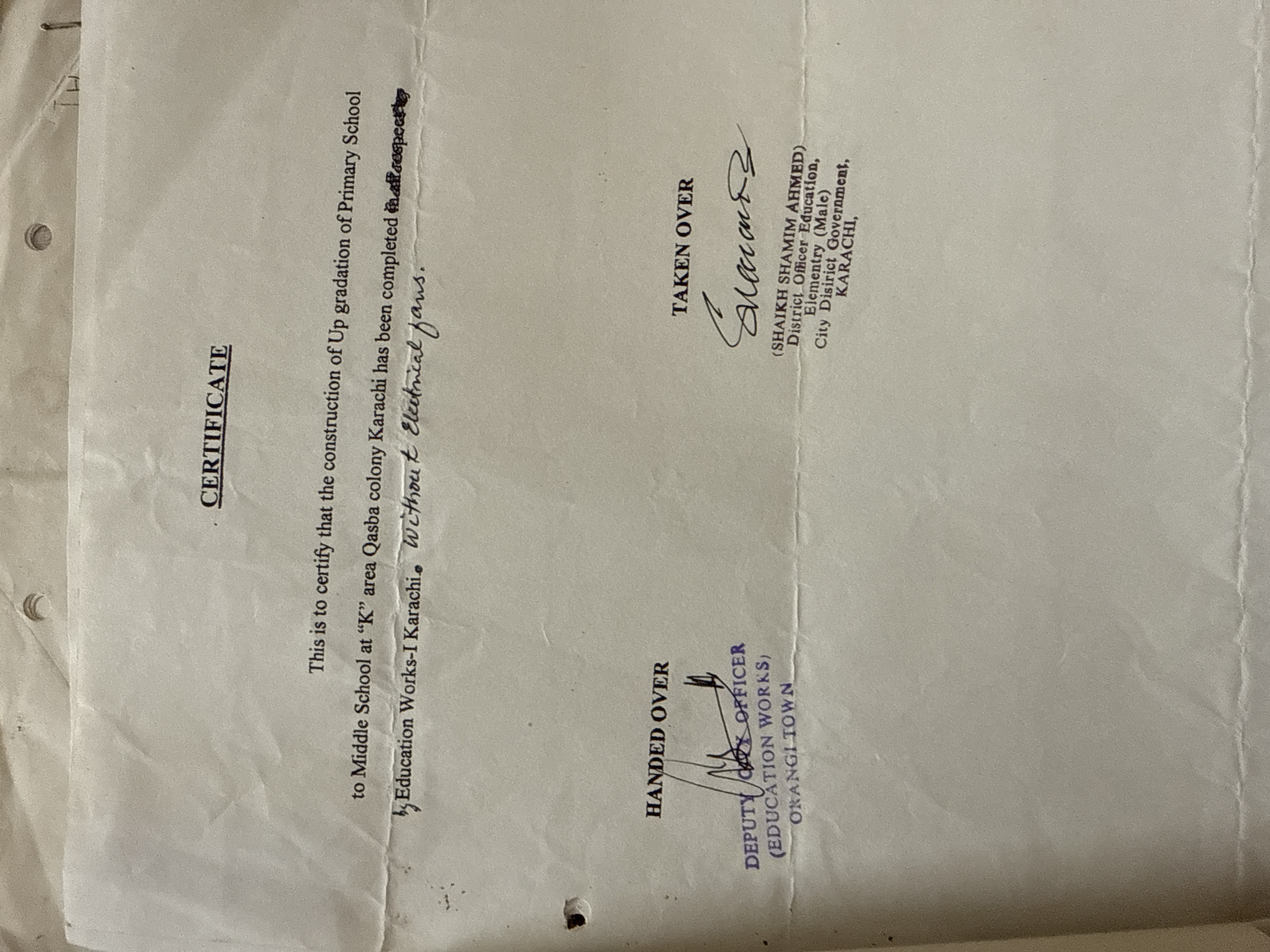
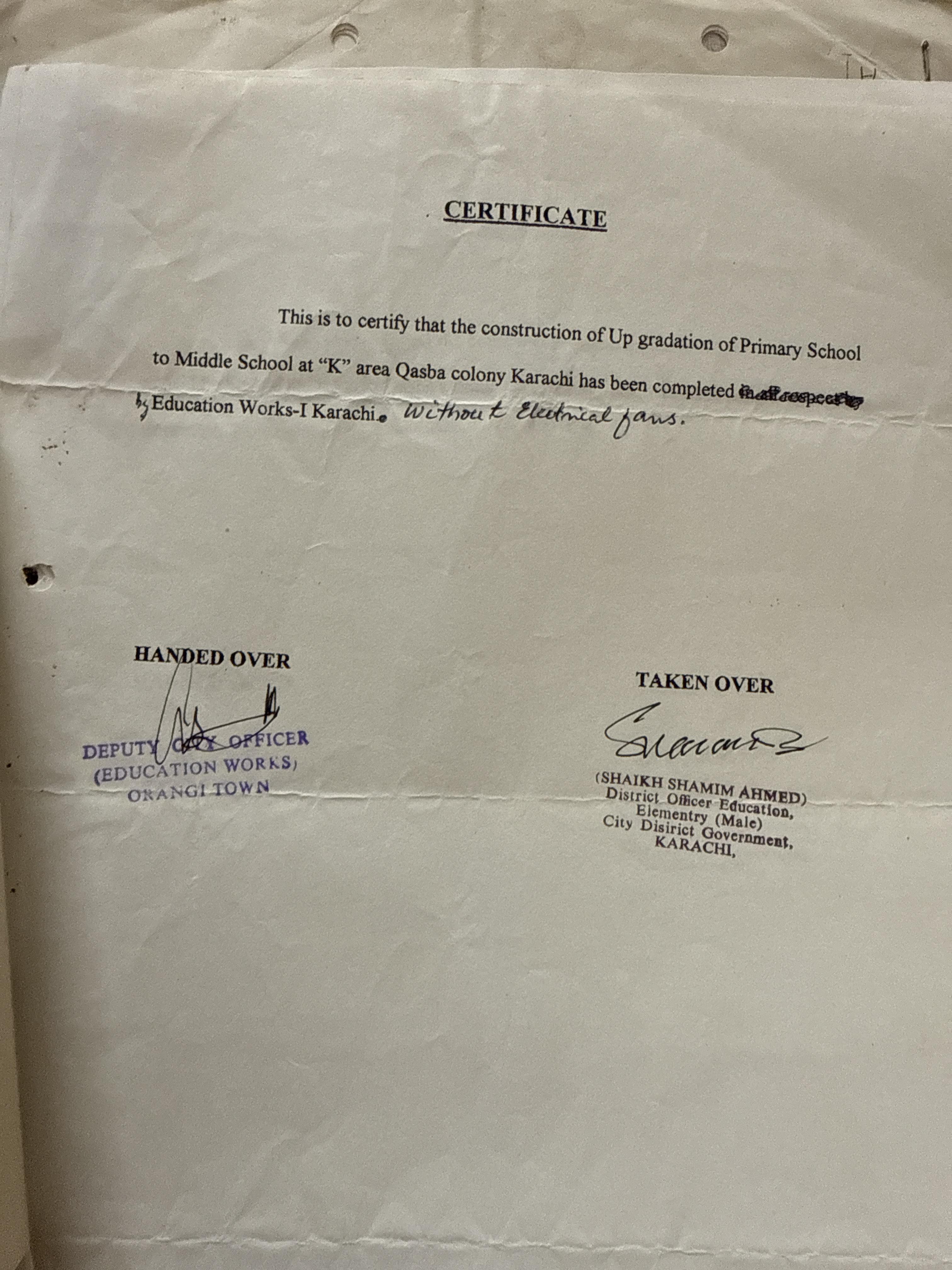
Formal completion and handing-over certificate: "construction of Up-gradation of Primary School to Middle School at 'K' area Qasba Colony Karachi has been completed in all respects by Education Works-I Karachi." Handed over by Deputy City Officer (Education Works), Orangi Town. Taken over by Shaikh Shamim Ahmed, District Officer Education (Male), City District Government, Karachi.
The formal completion certificate records two things without ambiguity:
- The construction work has been completed in all respects by Education Works-I Karachi
- The project was formally handed over by the Deputy City Officer (Education Works), Orangi Town, and taken over by Shaikh Shamim Ahmed, District Officer Education (Male), CDG Karachi
One annotation on the certificate deserves direct acknowledgement: the school was taken over without electrical fans. This is not a hidden deficiency, it is an honest, specific annotation that the civil and structural works were complete and certified, while the electrical fit-out had not been installed at the time of the formal handover of the building. Staged completion of this kind is standard practice in government contracts where MEP (mechanical, electrical, plumbing) installation is handled under a separate departmental instruction.
Which is precisely what happened next.
Handing-Over Certificate to the Electrical Division
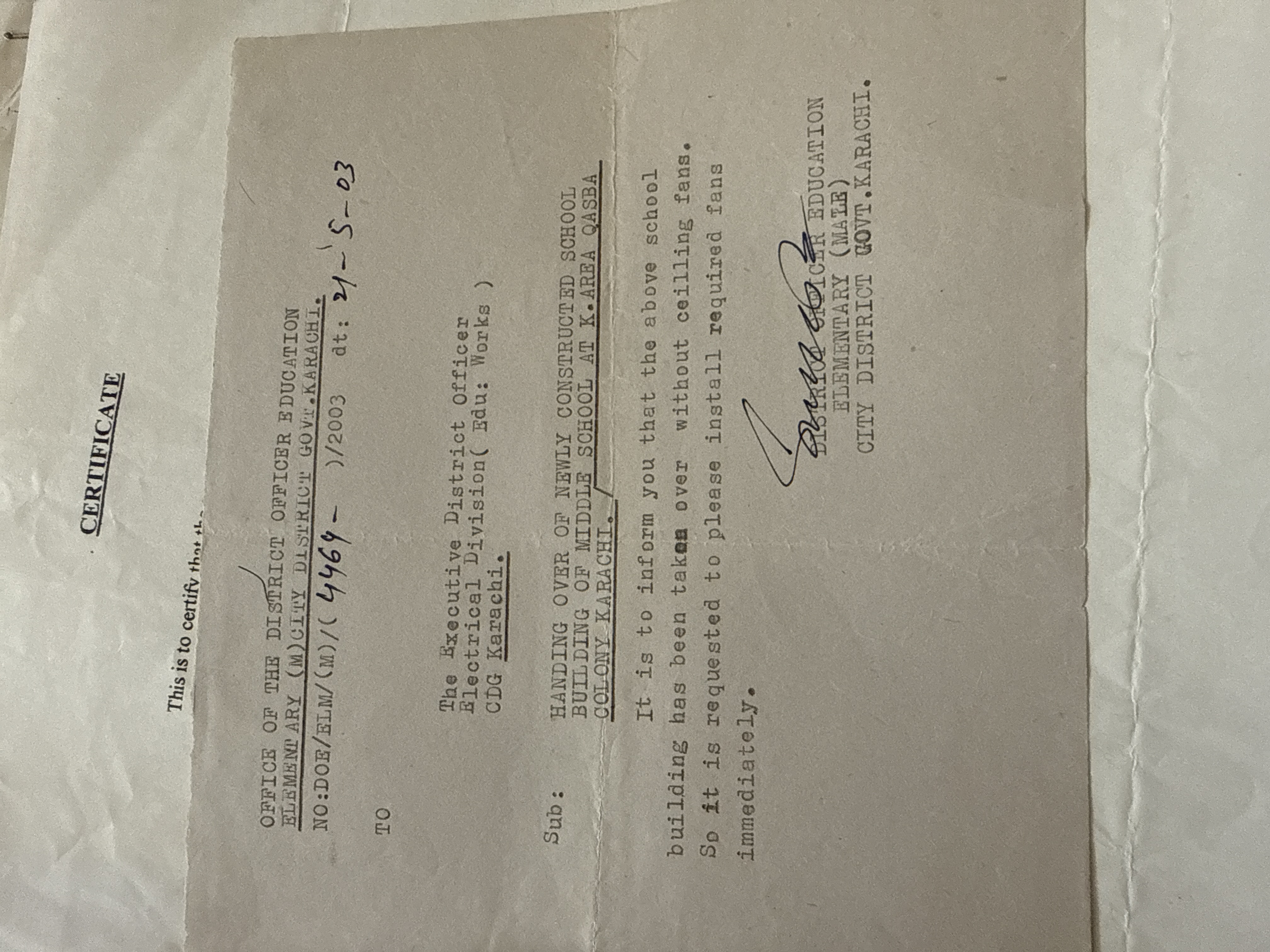
Handing-over certificate, Ref No. DOE/ELM/(M)/4469/2003, dated 21-5-2003. Office of the District Officer Education, Elementary (M), City District Govt. Karachi. To: Executive District Officer, Electrical Division, CDG Karachi. Subject: Handing Over of Newly Constructed School Building of Middle School at K. Area, Qasba Colony, Karachi, requesting immediate installation of ceiling fans.
The second document in the handover sequence is a formal internal government communication: the District Officer Education (Elementary, Male) writing to the Executive District Officer of the Electrical Division, confirming that the newly constructed school building at K Area, Qasba Colony has been taken over, and formally requesting the installation of the required ceiling fans, immediately.
Ref No. DOE/ELM/(M)/4469/2003. Dated 21 May 2003. This is the paper trail of a building that was built correctly, handed over correctly, and then handed off to the next department in the correct sequence. The construction was done. The next stage, electrification, was being triggered through the correct administrative channel.
This is what project completion looks like in the government of Karachi's documentation system. Not a single sign-off but a cascade: civil completion, formal handing over, formal taking over, and then a written instruction to the next department. Every step on paper.
The Challenges: Five Years, One Demanding Site
1. Constructing While the School Remained Open
The most operationally demanding aspect of this project was one it shared with every other institutional contract in Naffees & Sons' portfolio: the school kept running while the construction was underway. Students were present. Teachers were present. Examinations were held.
The management approach was the same that was applied on the SM Government Science College renovation in 2004–05 and the P&T Colony Model School conversion from 2007 to 2012: phased construction that isolated work zones, scheduled noisy structural trades, drilling, excavation, concrete pouring, outside examination periods and early in the working day before the campus reached full occupancy, and maintained daily debris removal so that the circulation routes and in-use areas were clean and safe at all times.
Five years is a long programme. Maintaining that site discipline consistently for the full duration required embedded supervision, not just a good plan on the first day.
2. Urban Density and Material Logistics in Qasba Colony
Qasba Colony is not an easy area to build in. The neighbourhood is densely built, with narrow internal roads and high pedestrian traffic. Getting construction materials, aggregate, cement, reinforcement bar, bricks, sand, shuttering timber, to the site required advance coordination and careful management of delivery windows. There was no space on site to stage large quantities of material; deliveries had to be timed to arrive when they were needed and could be handled directly.
Material wastage in a constrained urban site has to be controlled actively. There is no room for stockpiling, no buffer to absorb poor quantity estimation, and no easy way to remove large waste volumes without planning. The net saving of Rs.2,19,340 against the PC-I sanction is partly a reflection of how tightly the material quantities and site logistics were managed over five years in this environment.
3. Foundation Conditions in High-Density Urban Ground
The bill of quantities shows substantial excavation and substructure work, T-plinth, foundation concrete, and DWT construction. Urban ground in areas like Qasba Colony is not always predictable. Decades of settlement, adjacent informal construction, and utility lines whose routes are not reliably documented all create conditions that can produce surprises at excavation depth.
Where foundation conditions differed from the pre-contract assumption, the correct response was immediate: reassess the bearing capacity, adjust the foundation specification if required, document the change formally, and proceed with the Sub Engineer's knowledge and sign-off. These situations arise on every substantive foundation project; what distinguishes a well-managed site from a poorly managed one is whether they are handled transparently or quietly papered over.
4. Managing Government Approvals Across a Five-Year Programme
A project that runs from 1998 to 2003 passes through five government budget years, multiple officer postings on both the departmental and supervisory side, and multiple stage inspections. The Works & Services Department's stage-by-stage inspection and approval process does not slow down because a project has been running for four years, it is non-negotiable at every stage, regardless of how long the job has been going.
When supervising officers change, and over five years, they will, the incoming officer inherits a project with a history. The contractor who has maintained complete, orderly documentation from day one can brief any new officer on exactly where the project stands, what was done, what was approved, and what remains. Naffees & Sons' documentation discipline on this project is what enabled clean inspector handovers without contractual ambiguity.
5. Delivering Under a Government Sanction, No Room for Error
The PC-I sanction is not a budget ceiling that can be quietly exceeded. It is a formally approved maximum, and exceeding it requires a formal variation through the planning and finance authority, a process that can stall a project for months. Naffees & Sons delivered at Rs.33,42,174 against a sanction of Rs.35,61,514. Every rupee of that saving was a result of accurate measurement, disciplined buying, and the absence of rework. This is the outcome of a contractor who gets it right the first time, not one who corrects mistakes at their client's expense.
What This Contract Demonstrates
| Document | What It Confirms |
|---|---|
| Government Estimate Cover (M.B. No. 1469) | ADP project, Works & Services Dept CDG Karachi, Education Works-I, Naffees & Sons as executing contractor |
| Abstract of Cost (signed D.O. Education Works-I) | Full financial breakdown; PC-I Rs.35.6 lakh; actual Rs.33.4 lakh; saving Rs.2.19 lakh, government's own record |
| Bill of Quantities | Itemised external development scope, excavation, foundation, RCC, OHT, T-plinth, DWT, sanitary |
| Completion Certificate | "Completed in all respects", handed over by Deputy City Officer Orangi Town; taken over by D.O. Education Male CDG Karachi |
| Handing-Over Certificate (Ref 4469/2003) | Formal administrative completion, May 21, 2003, triggering electrification phase through correct departmental channel |
Five documents. Five independent government records confirming that Naffees & Sons executed this contract, from ADP sanction in June 1998 to formal handing-over in May 2003, under PC-I budget, completed in all respects, to the satisfaction of the District Officer Education, City District Government Karachi.
Contract Value in Today's Money
Rs.33,42,174 in 1998–2003 is not how this project should be understood in 2026.
Using SBP CPI data, Pakistan's cumulative inflation between 1998 and 2025 is approximately 6–7×. On that basis:
- Actual project cost (Rs.33,42,174) ≈ Rs.2 crore at 2026 prices
- PC-I sanctioned (Rs.35,61,514) ≈ Rs.2.1 crore at 2026 prices
A two-crore-rupee school upgradation contract, ADP-funded, Works & Services Department-supervised, delivered under budget in full, formally handed over with complete documentation, in Karachi's Orangi Town in 1998. That is the scale of this contract in real terms. Naffees & Sons was selected to deliver it, and did.
Part of a Longer Record
The Qasba Colony upgradation is one project in a portfolio of government education construction contracts that runs from the early 2000s through to the present decade. In the same period:
GPS Abdul Ghaffar, Burpat, Gadap (2002–03), Construction of a two-classroom permanent building for a shelterless primary school in Gadap Town, ADP contract, Works & Services Department, under Rs.2 lakh, a remote site, a different set of challenges, the same documentation standard.
SM Government Science College, Saddar (2004–05), Rs.48 lakh two-phase renovation contract across Khairpur House and the Hassan Ali Block; three principal-signed completion certificates and a Certificate of Appreciation six years post-handover.
P&T Colony Model School Conversion, Saddar Town (2007–12), Rs.96 lakh, five-year ADP programme, four work orders, full architectural drawings, handing-over certificate with site photographs.
The thread across all four is the same: government-commissioned, formally documented, completed as specified, handed over on record. Each project adds another layer to a standing built over more than five decades of government contract delivery in Karachi.
Government education infrastructure is not glamorous work. It does not attract press attention. It does not come with easily photographed showcase interiors. What it comes with is this: the knowledge that a child in Qasba Colony in 2003 had a proper middle school building to walk into, because a contractor showed up, managed the site, handled the documentation, delivered under budget, and handed over correctly.
That is what Naffees & Sons has been doing in Karachi since 1972.
Considering a Government or Institutional Construction Project in Karachi?
Naffees & Sons has been executing ADP and government construction contracts across Karachi since 1972, schools, colleges, community facilities, and institutional buildings, from remote Gadap tehsil to the dense urban fabric of Orangi Town and Saddar. We hold approved government contractor status under the Works & Services Department and have a documented record of delivery across both new construction and renovation contracts.
If you are responsible for a government or institutional project, upgradation, new construction, renovation, external development, or utility overhaul, we would be glad to assess the scope and give you an honest view of what the work will cost and how it should be approached.
Contact us for a consultation and site assessment →
Naffees & Sons | B-142, Block A, North Nazimabad, Karachi | Chat on WhatsApp
Related Projects
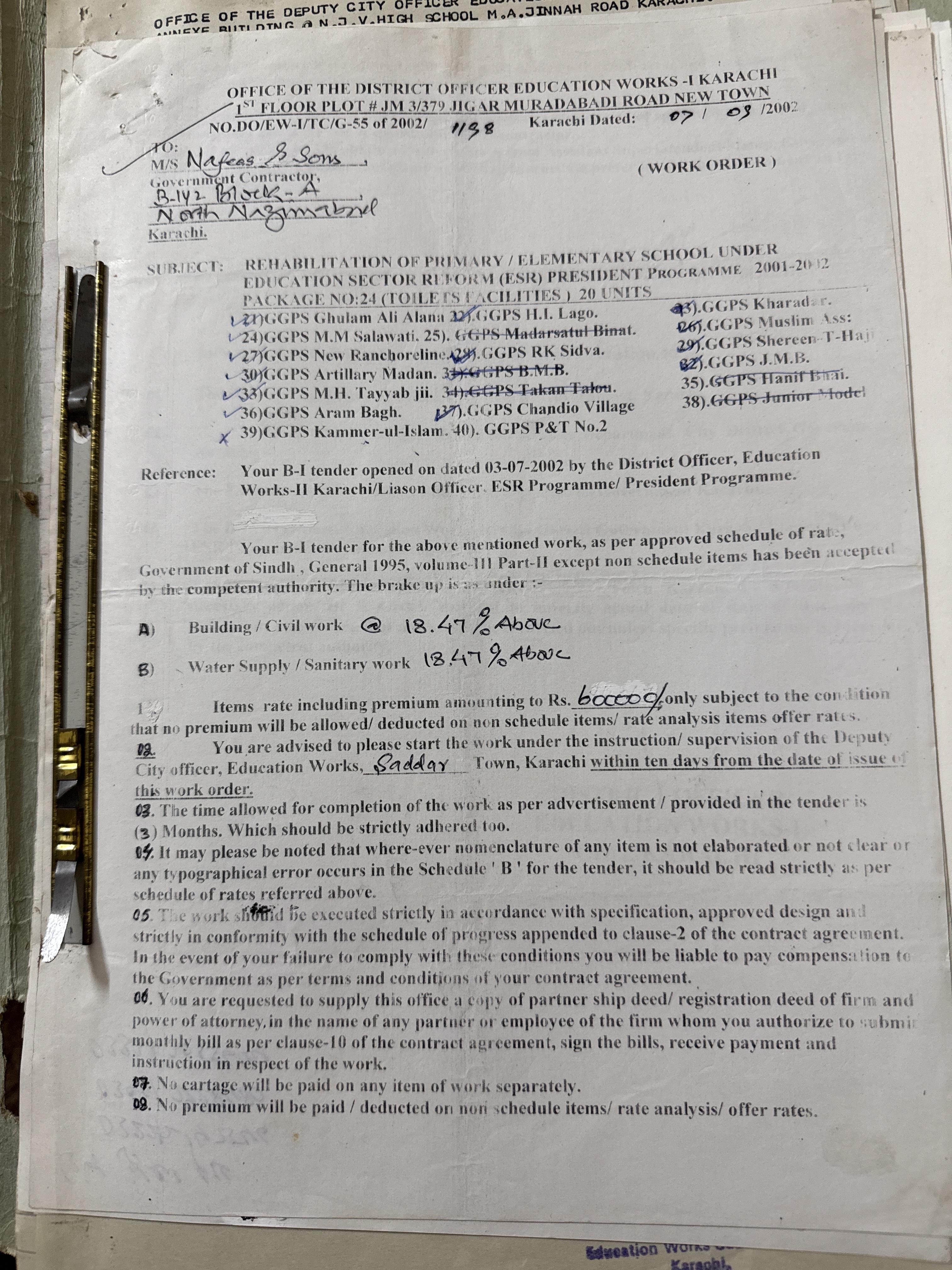
President's Education Sector Reform Programme, Multi-School Toilet Rehabilitation, Karachi (2001–06)
Saddar Town, Karachi — 2001
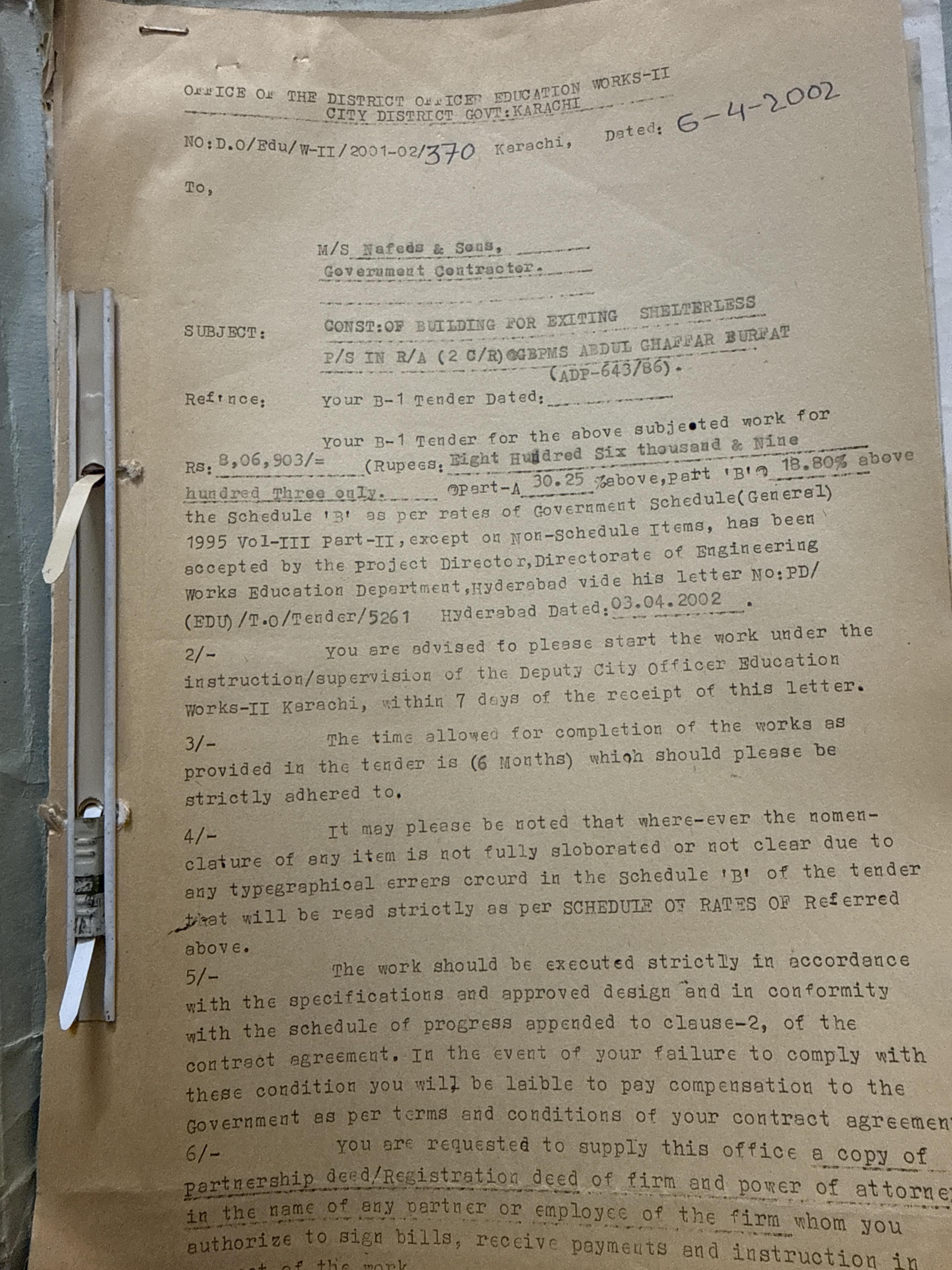
GPS Abdul Ghaffar Shelterless School, Two-Classroom Construction, Gadap, Karachi (2002–03)
Burpat, Gadap Town, Karachi — 2002
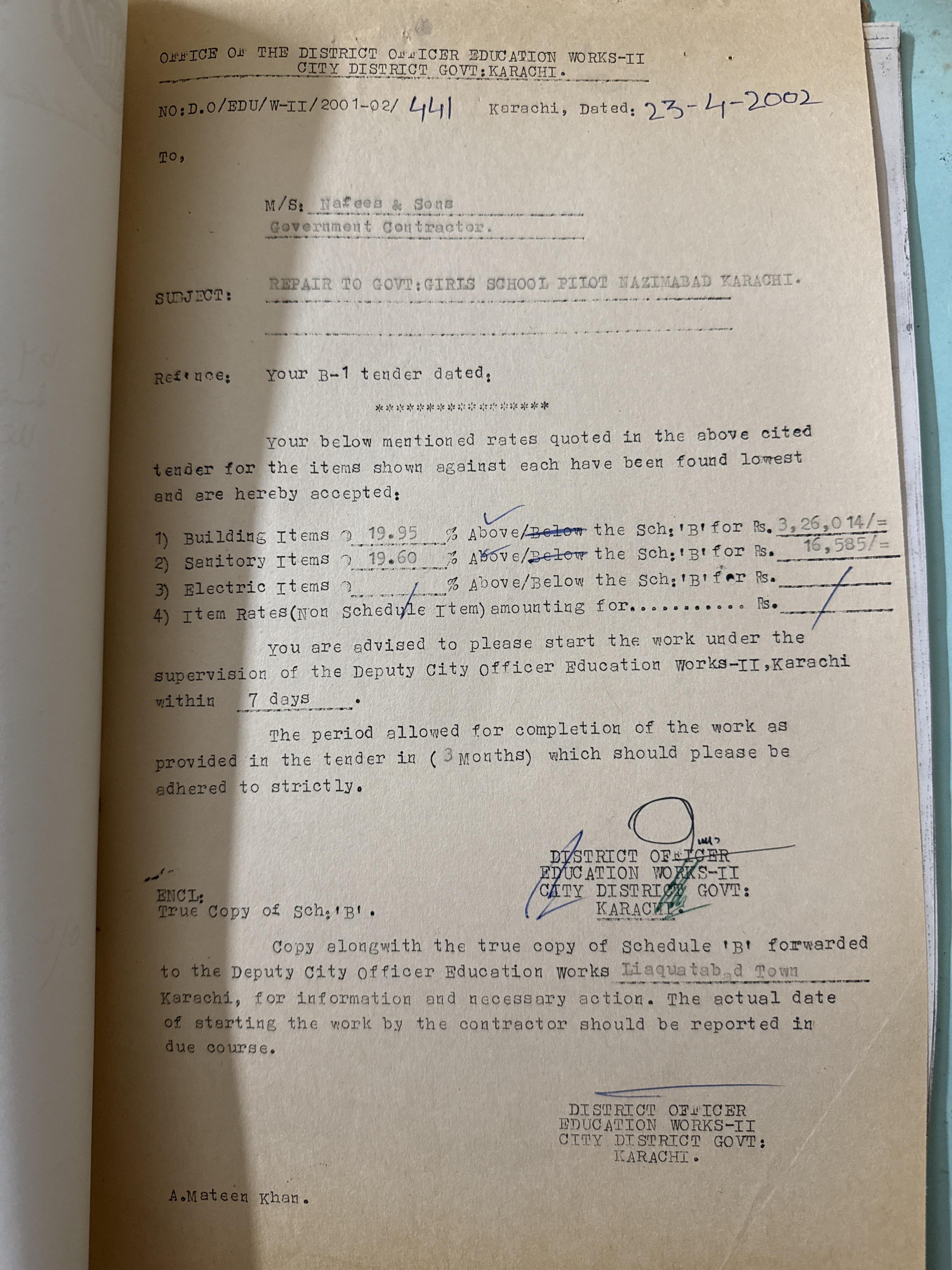
Govt. Girls Pilot Higher Secondary School Renovation, Nazimabad Karachi, Provincial Technical Sanction (2002)
Nazimabad No.1, Karachi — 2002