Compound Wall & Pump Room, Govt. Girls' Secondary School No.14, Sirjani Town, Karachi (2000–01)
Sector 5-D, Sirjani Town, Karachi-West — 2000
A boundary wall around a government girls' school is not a minor item. It is, in the most fundamental sense, a safety infrastructure. For a girls' secondary school in a densely populated area of Karachi-West, the integrity of the compound wall is what defines the boundary between the school as a secure environment and the street. A wall that is deteriorated, breached, or incomplete is not just a maintenance problem, it is a risk to the institution and to every student inside it.
The project Naffees & Sons executed at Government Girls' Secondary School No.14 in Sector 5-D, Sirjani Town, Karachi-West in 2000–01 addressed exactly this. A formal B-1 government tender was issued, a work order was signed by the Executive Engineer of Education Works Division West, a work instruction was issued by the Assistant Engineer of the Education Works Sub-Division, Orangi Town, and Naffees & Sons executed the compound wall and pump room to the satisfaction of the school's Head Mistress, who put that satisfaction in writing.
This case study documents the contract, the work, the government approval chain, and what it means to have this kind of institutional endorsement in a contractor's record.
The Contract: Education Works Division West, CDG Karachi
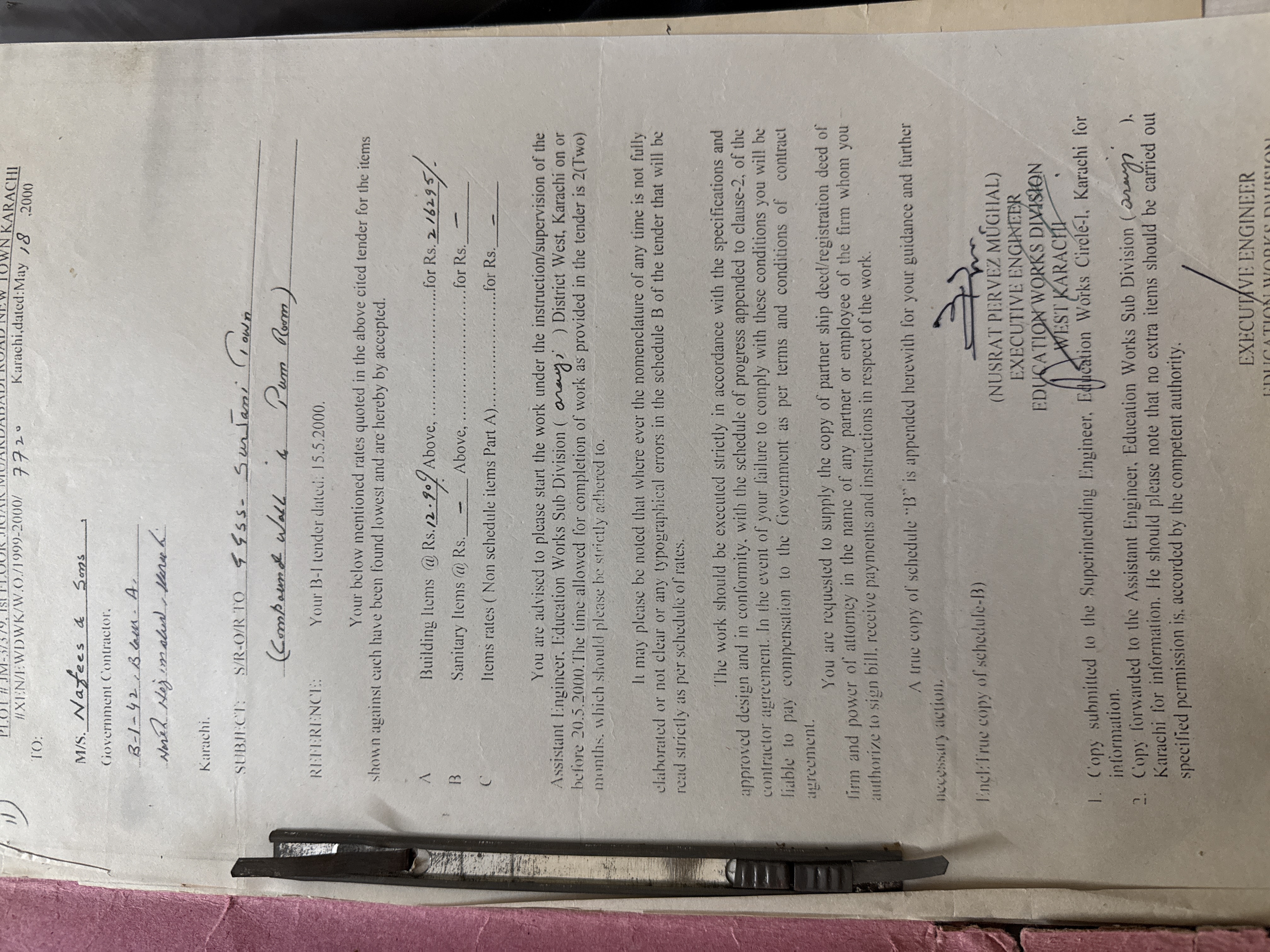
Work order Ref: JME/3/37-B/TEFDWK-W/99-2000/7725, dated May 18, 2000. To: M/S Nafees & Sons, Government Contractor, B-192, Block A, North Nazimabad, Karachi. Subject: Compound Wall & Pump Room, Surjani Town Sector No.14. Building items @ 12.90% above schedule. Signed by Nusrat Pervez Mughal, Executive Engineer, Education Works Division West, Karachi.
The contract was issued through the standard government B-1 tender process, the formal competitive tendering mechanism used by the Works & Services Department, CDG Karachi for school-level civil works contracts. Naffees & Sons submitted a B-1 tender on May 15, 2000. Three days later, the Executive Engineer issued the work order.
Awarding authority: Education Works Division West, CDG Karachi
Signing officer: Nusrat Pervez Mughal, Executive Engineer, Education Works Division West
Supervising authority: Education Works Sub-Division, Orangi Town
Contractor: M/S Nafees & Sons (Naffees & Sons), Government Contractor, Karachi
Work order reference: JME/3/37-B/TEFDWK-W/99-2000/7725
Date of work order: May 18, 2000
Tender reference: B-1, dated May 15, 2000
Scope: Compound Wall and Pump Room, G.G.S. Surjani Town Sector No.14
Rate: Building items at 12.90% above government schedule of rates
Contract value: Approximately Rs.21,875/-
At 2026 purchasing power, using SBP CPI data showing approximately 6–7× inflation since 2000, this contract represents approximately Rs.1.3–1.5 lakh in today's money.
Two things about the work order are worth noting. First, the rate: 12.90% above the government schedule of rates. The schedule of rates is the Works & Services Department's own published reference for the cost of construction activities. A bid at 12.90% above schedule is a competitive rate for a government contractor in 2000, not a padded bid, and not a bid so low it creates execution problems. It is the rate of a contractor who knows their costs and tenders honestly.
Second, the timeline: tender submitted May 15, work order issued May 18. Three days from tender submission to formal work order. That is an efficient government procurement sequence, and it means the Executive Engineer had confidence in Naffees & Sons' submission from the outset.
The Work Instruction: Assistant Engineer, Orangi Town
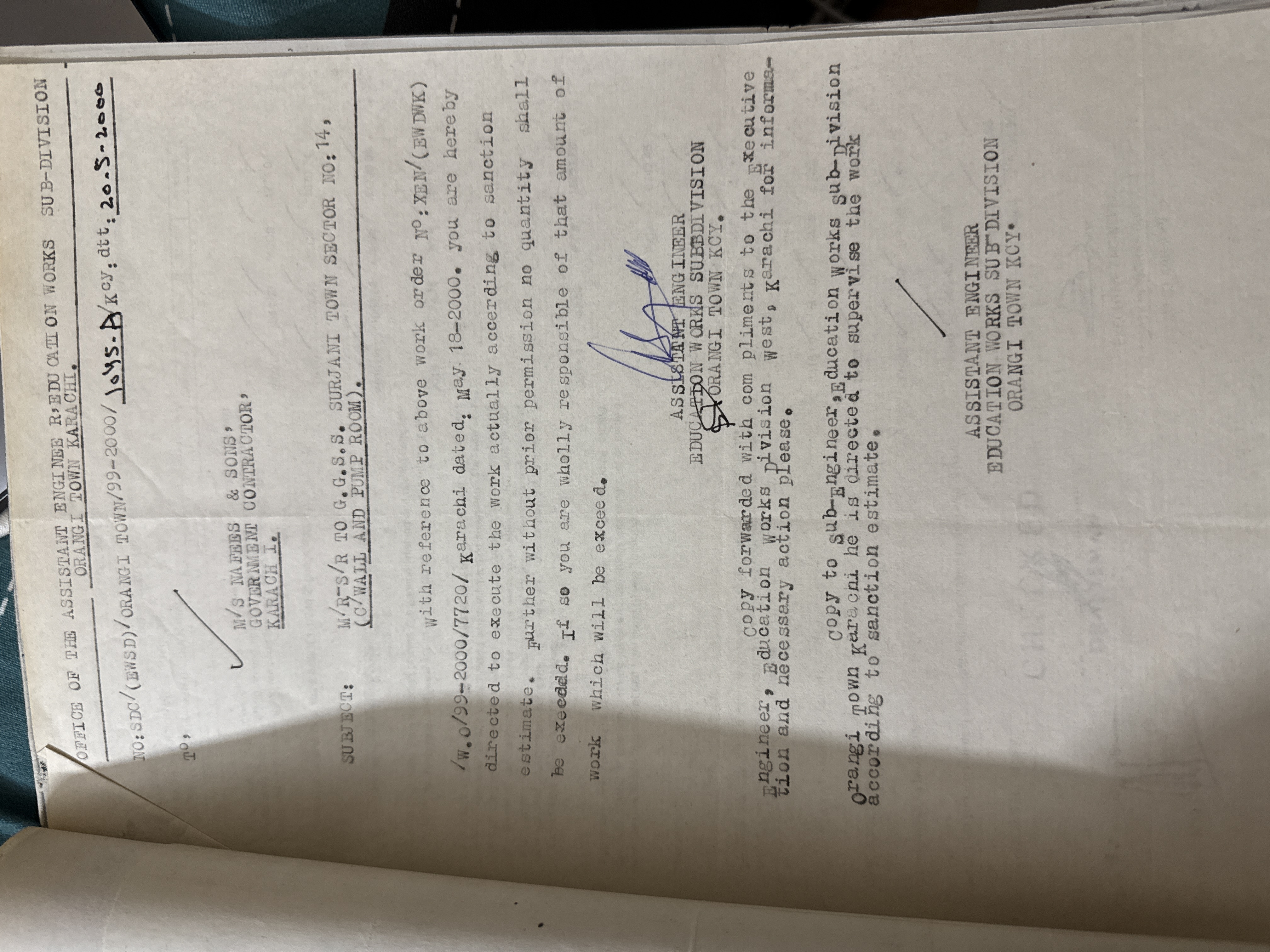
Work instruction Ref: DX/EWSD/Orangi Town/99-2000/1045-D/KCY, dated May 20, 2000. From: Assistant Engineer, Education Works Sub-Division, Orangi Town, Karachi. To: M/S Nafees & Sons, Government Contractor, Karachi. Directing execution of compound wall and pump room at G.G.S. Surjani Town Sector No.14 per sanctioned estimate. Copies to Executive Engineer Education Works Division West and Sub-Engineer for site supervision.
Two days after the Executive Engineer's work order, the Assistant Engineer of the Education Works Sub-Division in Orangi Town issued the formal work instruction to Naffees & Sons. This document carries three critical elements:
1. Direct instruction to execute per sanctioned estimate. The Assistant Engineer explicitly directs Naffees & Sons to execute the work "actually according to sanction estimate." This is the formal boundary of the contract scope, the contractor is authorised to execute what is in the estimate, no more, no less. Any quantity excess requires prior permission; if exceeded without approval, the contractor bears the cost.
2. Supervision assignment. The Sub-Engineer of the Education Works Sub-Division was copied and directed to supervise the work according to the sanction estimate. This means a government-employed site supervisor was assigned to this contract, physically present on site during execution, measuring completed work against the estimate, and signing off on progress. There was no self-certification on this job. The government supervised the work.
3. Information copy to Executive Engineer. The work instruction was also forwarded to the Executive Engineer, Education Works Division West, for information and necessary action. The chain from Executive Engineer (work order) down to Assistant Engineer (work instruction) to Sub-Engineer (site supervision) is complete and documented.
This is the government contracting apparatus functioning as it is designed to: multiple layers of authorisation, clear accountability at each level, and a paper record of every instruction issued. Naffees & Sons operated within this framework correctly throughout.
The School: Govt. Girls' Secondary School No.14, Sirjani Town
Government Girls' Secondary School No.14 is located in Sector 5-D, Sirjani Town, a large residential township in Karachi-West that developed substantially through the 1990s as the city's population expanded into its western periphery. Sirjani Town, built as a formal housing scheme, absorbed large numbers of families from across the city and developed its own network of government schools, clinics, and civic infrastructure.
A girls' secondary school in this environment serves a population of students who may not otherwise have easy access to secondary education. Government Girls' Secondary School No.14, running a morning shift, is part of the essential civic infrastructure of the area.
The compound wall of a girls' school in Karachi-West is not a routine maintenance item. It defines the physical security of the school environment, determining who can enter the campus and, critically, who cannot. A boundary wall that is in poor condition, with gaps or deteriorated sections, is a compound security and safety problem that no school administration can ignore. When the Education Works Division West included this school's compound wall in a formal works programme for 2000, it was a recognition that the condition of the wall had crossed the threshold where it needed to be properly addressed, not patched.
The pump room is the facility that houses the school's water pump, the equipment that delivers water from the underground supply or storage to the school's water points and bathroom facilities. Without a properly constructed, secure pump room, the water supply infrastructure of the school is exposed to the elements and to tampering. A school that cannot reliably provide water to its students and staff on a working day is a school with a fundamental operational problem.
Together, the compound wall and pump room represent two of the most basic functional infrastructure elements of a functioning school campus.
Scope of Work
Compound Wall (Boundary Wall)
The compound wall scope covered the construction or restoration of the boundary wall around the school campus perimeter. Government school boundary walls in Karachi are typically brick masonry structures, foundations at appropriate depth, brick courses in cement mortar to the specified height, rendered on both faces, with coping at the top to prevent water penetration at the wall's most exposed point.
The wall serves multiple purposes simultaneously: it defines the school's boundary on the land record, it provides physical separation between the school compound and the surrounding streets, and it forms the security perimeter within which the school operates. A girls' school in particular relies on this perimeter to function as a safe, controlled environment.
The work instruction's explicit direction to execute "according to sanction estimate" and the subsequent supervision by the government's Sub-Engineer means that every element of the wall, foundation dimensions, brick course heights, mortar specification, render thickness, coping detail, was executed to the government's specified standard and measured on site. There was no shortcutting on a supervised government contract.
Pump Room
The pump room is a separate masonry structure, typically a small enclosure sized to house the pump motor, its electrical panel, and any associated pipework, that protects the school's water pumping equipment from exposure and provides controlled access for maintenance. A well-built pump room is a permanent structure: properly founded, properly roofed, with a secure door and appropriate ventilation.
In the context of a government school in Sirjani Town in 2000, a permanent, properly constructed pump room was the difference between a water supply system that could be maintained and protected over its service life, and one exposed to weather, theft, and accidental damage. The pump room constructed by Naffees & Sons on this contract was built to Works & Services Department specification, the same specification that applies to every other element of government school construction in Karachi.
The Satisfaction Certificate: Head Mistress, Govt. Girls' Secondary School No.14
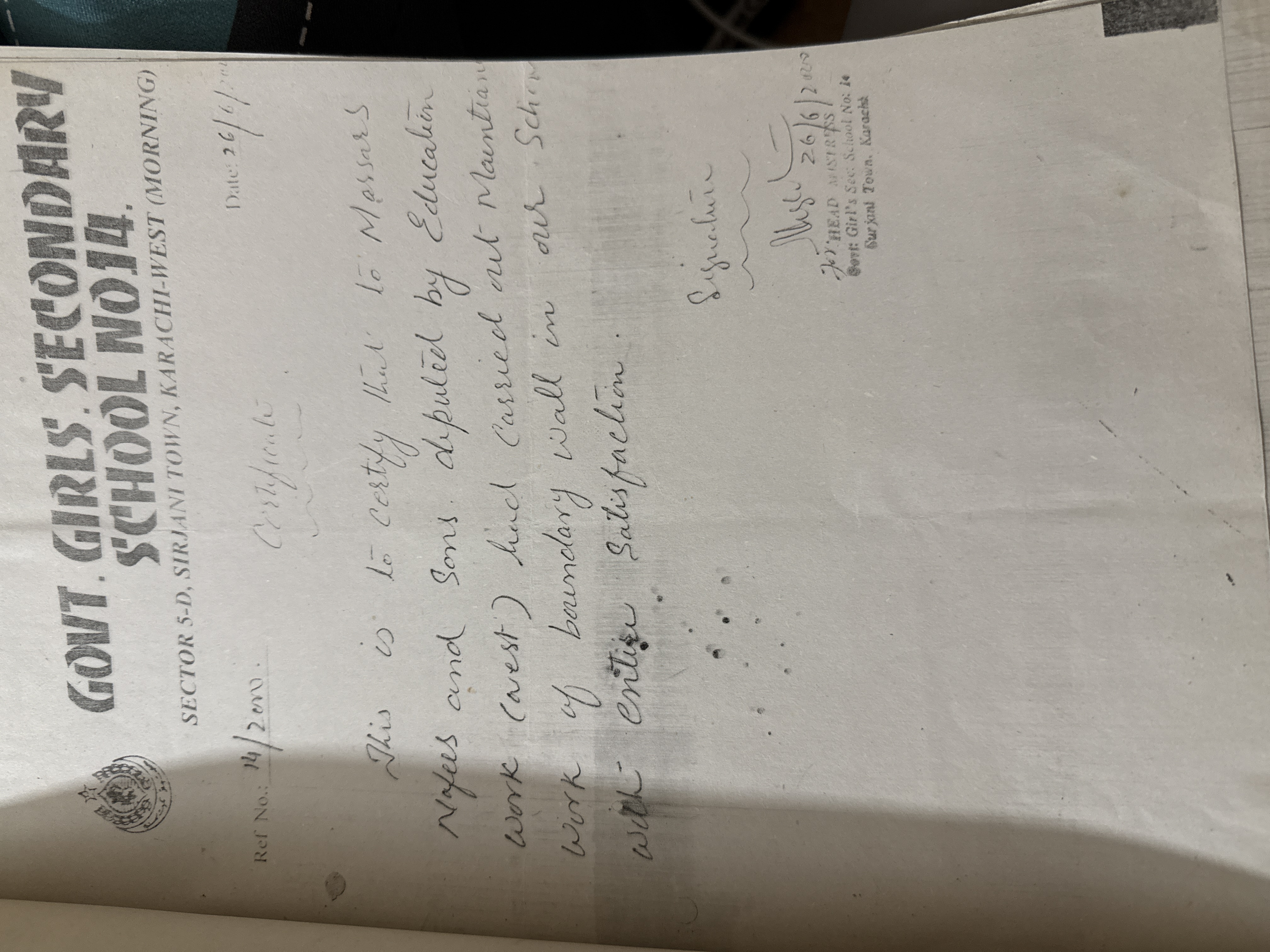
Certificate, Ref No: 18/2001, dated 26/6/2001. Official letterhead: Govt. Girls' Secondary School No.14, Sector 5-D, Sirjani Town, Karachi-West (Morning). Signed by Head (Head Mistress): "This is to certify that to Messrs Nafees and Sons, deputed by Education Work (West) had carried out maintenance work of boundary wall in our School with entire Satisfaction."
The Head Mistress of Government Girls' Secondary School No.14 issued this certificate in June 2001, after the work had been completed, inspected, and in use. It is written on the school's official letterhead, carries the school's stamp, and is signed by the Head Mistress personally.
The language is precise: the work was carried out with entire Satisfaction. Not adequate satisfaction. Not partial satisfaction. Entire.
A school principal or Head Mistress does not issue a certificate like this as a formality. It requires a decision to put the school's official stamp and their own signature to a document endorsing a contractor's work. That decision is made when the work was done properly, when the boundary wall that was constructed or restored looked correct, was structurally sound, and had addressed the problem it was commissioned to solve. When the pump room was properly built and functioning as it should.
The certificate is dated June 2001, approximately a year after the May 2000 work order. The Head Mistress saw the school through an academic year with the completed wall and pump room in place before issuing this endorsement. That is not a rushed sign-off. It is a considered assessment from the person most directly responsible for the school's day-to-day operation.
The Challenges: What This Contract Required
1. Sirjani Town's Developing Infrastructure in 2000
In 2000, Sirjani Town was in an intermediate stage of development, a large formal housing scheme with established residential occupancy, but with infrastructure that had not yet reached the completeness of Karachi's older neighbourhoods. Roads in some sectors were partially developed. Utilities were present but not always fully reliable. Construction logistics, moving materials, bringing in equipment, managing waste, required the kind of site-level problem solving that comes from experience with Karachi's varied construction environments.
Naffees & Sons had, by 2000, been working across Karachi's construction landscape for nearly three decades. Navigating a Sirjani Town site in 2000 was not unfamiliar territory.
2. Government Estimate Discipline, No Excess Without Permission
The work instruction from the Assistant Engineer contains an explicit clause: no quantity shall be exceeded without prior permission, and if it is, the contractor bears the cost. This is standard government contract language, but it carries real weight. If the wall excavation reveals conditions that require deeper foundations, or if the boundary length requires more courses than estimated, the contractor must stop, report, get written authorisation, and only then proceed.
This requires site discipline and administrative rigour. A contractor who exceeds quantities without authorisation and then argues the case at final measurement creates disputes, delays, and the kind of friction that damages a working relationship with the supervising engineer. Naffees & Sons executed this contract within the sanctioned estimate, evidenced by the clean, unconditional satisfaction certificate that followed.
3. Coordinating With a Functioning School
The school was in operation during the works. Boundary wall construction is inherently disruptive, excavation along the perimeter, brickwork in progress, construction materials staged within or adjacent to the compound. Managing this alongside a running school with students, staff, and a morning shift timetable required coordination with the school administration to keep the construction activity clear of the student movement paths, and to avoid any disruption to the school's functioning.
The Head Mistress, when she eventually issued the satisfaction certificate, was acknowledging not just the quality of the finished work, but the manner in which the work was carried out, because a Head Mistress whose school day was consistently disrupted by a badly managed construction site would not describe the experience as producing "entire Satisfaction."
4. The Three-Layer Government Approval Structure
This contract involved three distinct government actors: the Executive Engineer (issued the work order), the Assistant Engineer (issued the work instruction and managed the supervision), and the Sub-Engineer (physically supervised the work on site). Each had their own reference number, their own copy of instructions, and their own accountability for their part of the process.
Working correctly within a three-layer government structure means understanding what each level needs, what documentation the Sub-Engineer requires for site sign-offs, what reporting the Assistant Engineer expects, and how variations or issues are escalated to the Executive Engineer. Naffees & Sons' long experience with government contracting in Karachi is what makes this navigation routine rather than a source of confusion or delay.
What This Contract Demonstrates
| Document | What It Confirms |
|---|---|
| Work order (Ref JME/3/37-B/TEFDWK-W/99-2000/7725, 18 May 2000) | B-1 tender process completed; contract awarded by Executive Engineer, Education Works Division West |
| Work instruction (Ref DX/EWSD/Orangi Town/99-2000/1045-D/KCY, 20 May 2000) | Formal site execution direction; Sub-Engineer assigned for supervision; three-layer government oversight confirmed |
| Head Mistress satisfaction certificate (Ref 18/2001, June 2001) | Compound wall and pump room completed "with entire Satisfaction", school's own formal endorsement |
Three documents. A complete government contracting paper trail from B-1 tender through formal work order, work instruction with supervision assignment, and post-completion institutional endorsement. This is what a correctly executed government school contract looks like.
Scale and Context: Why Smaller Contracts Matter
The contract value on this project, approximately Rs.21,875/-, is the smallest in Naffees & Sons' documented portfolio. At 2026 prices, it represents approximately Rs.1.3–1.5 lakh.
It would be easy to dismiss a project at this scale as an outlier or a footnote. That would be the wrong reading.
Government contracting in Karachi operates on a continuous spectrum, from the Rs.96 lakh P&T Colony Model School conversion that ran for five years, to the Rs.48 lakh SM Science College renovation, to the Rs.35 lakh Qasba Colony school upgradation, to the Rs.22,000 compound wall and pump room at Sirjani Town. A contractor that is trusted with only the large contracts, and cannot execute the small ones correctly, is not a reliable government contractor. It is a contractor that does well when the fees are high and the supervision is intense.
The definition of a contractor that government departments keep returning to, across decades, across contract sizes, across administrative changes, is one that brings the same discipline and the same execution quality to every job on the list, regardless of value. Naffees & Sons has been on government works lists in Karachi since 1972. The compound wall at Govt. Girls' Secondary School No.14 in Sirjani Town is on record alongside the college renovations and the model school conversions because it was executed with the same rigour and to the same standard.
The Head Mistress of a government girls' secondary school in Karachi-West used the words "entire Satisfaction." That is not a grade that varies with the size of the contract.
Part of a Longer Record of Government School Work
The Sirjani Town compound wall project sits within a portfolio of government education infrastructure contracts that spans more than two decades:
- GPS Abdul Ghaffar, Gadap Town (2002–03), ADP contract for a two-classroom permanent building for a shelterless primary school; Works & Services Department, remote peri-urban site
- Primary to Middle School Upgradation, Qasba Colony (1998–2003), Rs.35.6 lakh PC-I, five-year programme, completed under budget with Rs.2.19 lakh net saving to government
- SM Government Science College, Saddar (2004–05), Rs.48 lakh two-phase renovation, three principal-signed completion certificates, Certificate of Appreciation in 2010
- P&T Colony Model School Conversion, Saddar Town (2007–12), Rs.96 lakh, four work orders, five-year programme, handing-over certificate with site photographs
Each project is a different scale, a different location, a different scope. All of them are executed by the same contractor, to the same standard, with the same documentation discipline. The Sirjani Town compound wall is not the largest project in this portfolio. It is, however, proof that the standard does not depend on the size of the fee.
Government School Infrastructure in Karachi: The Contractor That Shows Up For Every Job
Government schools across Karachi, from Sirjani Town in the west to Gadap in the east, from Saddar's historic institutions to Orangi Town's dense urban fabric, require a continuous programme of construction, renovation, and maintenance. Boundary walls deteriorate. Pump rooms fail. Classrooms need renovation. New schools need to be built for communities without them.
The contractors who execute this work reliably, correctly, and to government specification are the ones that stay on approved contractor lists across administrations. Naffees & Sons has been on those lists since 1972. The Sirjani Town compound wall, a modest contract, a single school, a clean satisfaction certificate, is exactly the kind of project that explains why.
If you are responsible for a government school, college, or institutional building in Karachi that needs any civil works, new construction, renovation, boundary wall, pump room, utility infrastructure, or structural repair, Naffees & Sons has the approvals, the track record, and the site management experience to execute it correctly.
Contact us for a site assessment and honest estimate →
Naffees & Sons | B-142, Block A, North Nazimabad, Karachi | Chat on WhatsApp
Related Projects
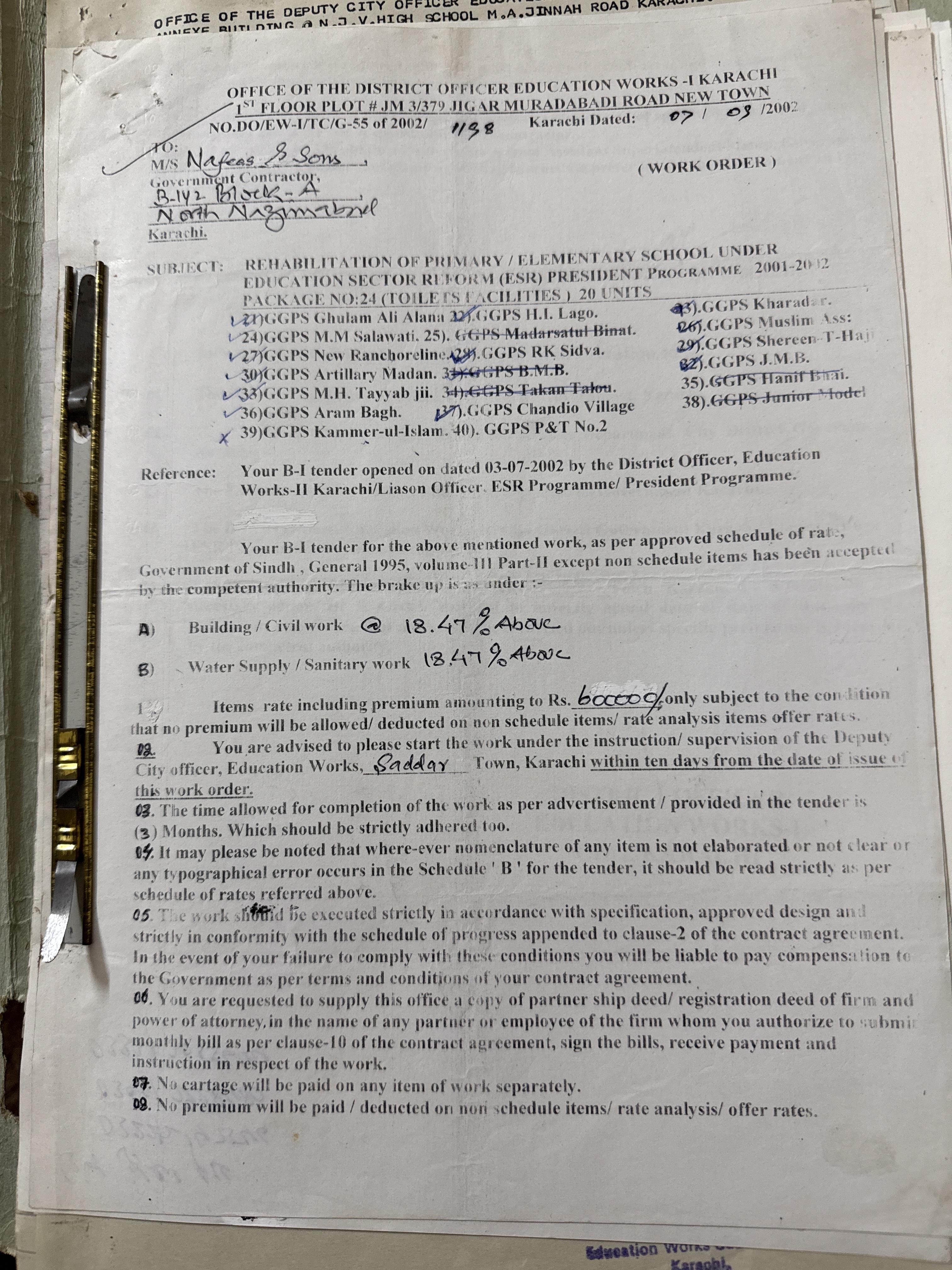
President's Education Sector Reform Programme, Multi-School Toilet Rehabilitation, Karachi (2001–06)
Saddar Town, Karachi — 2001
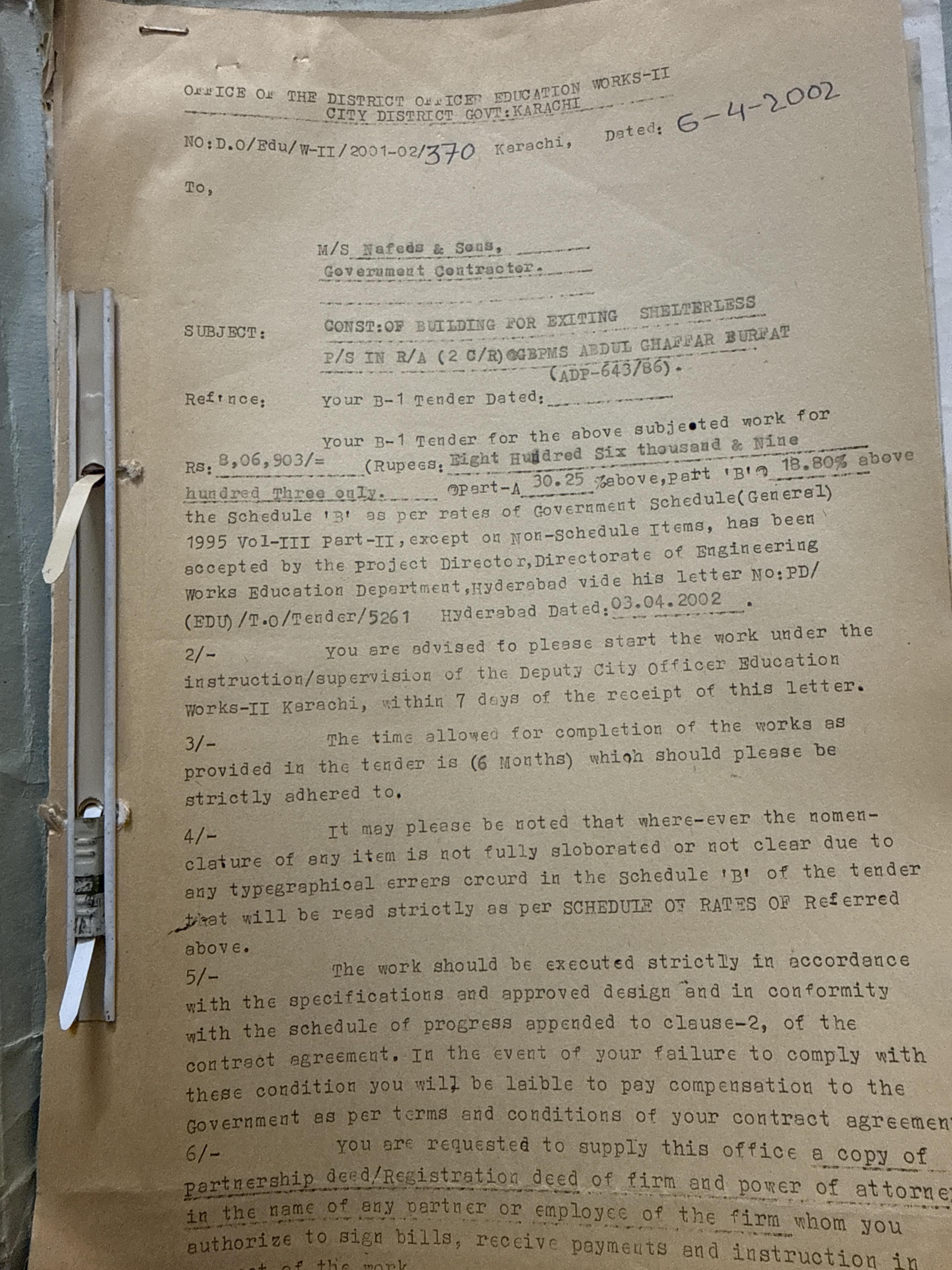
GPS Abdul Ghaffar Shelterless School, Two-Classroom Construction, Gadap, Karachi (2002–03)
Burpat, Gadap Town, Karachi — 2002
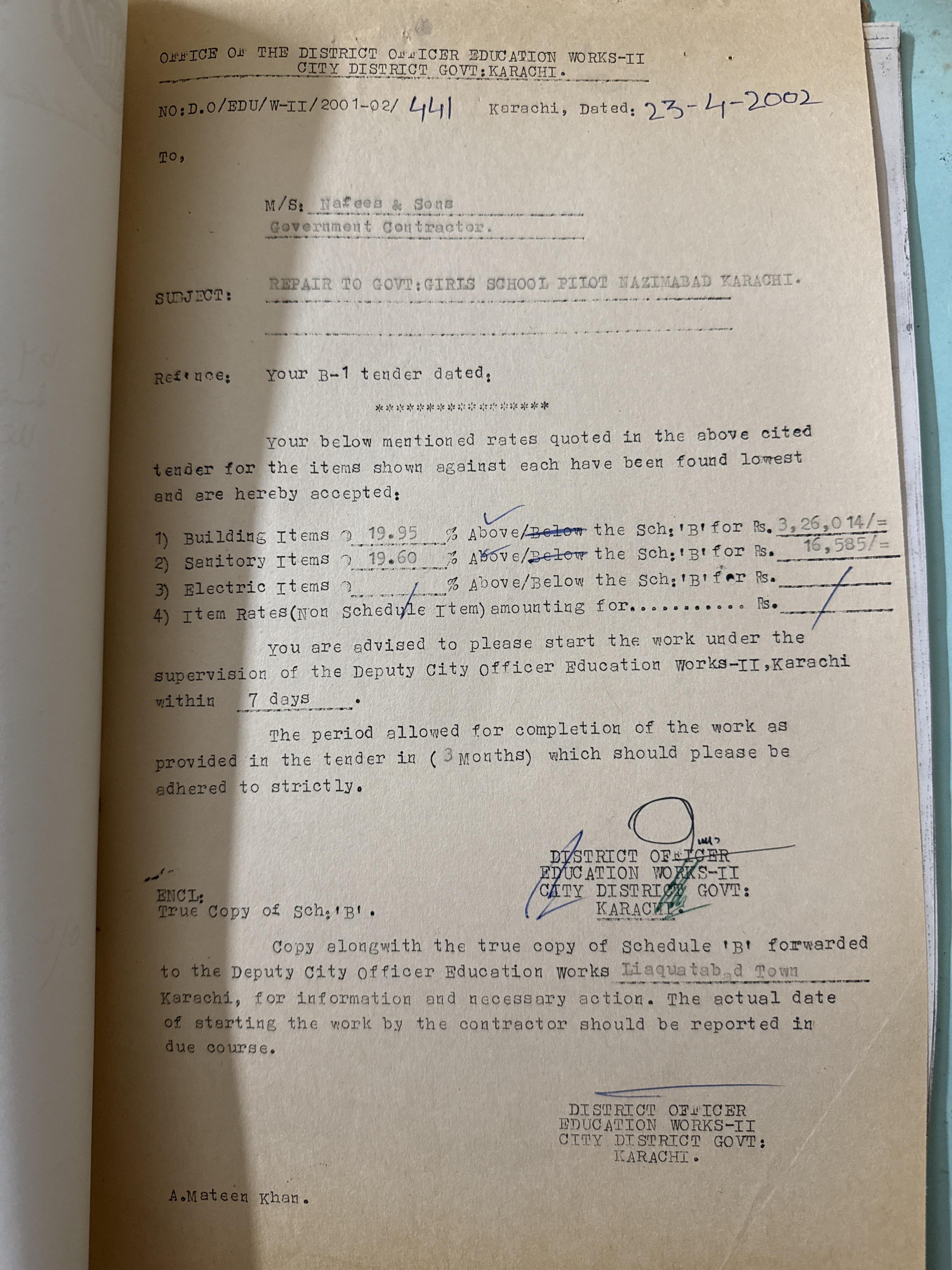
Govt. Girls Pilot Higher Secondary School Renovation, Nazimabad Karachi, Provincial Technical Sanction (2002)
Nazimabad No.1, Karachi — 2002