Ask five Karachi homeowners what demolishing their old house will cost before the rebuild starts, and four of them will guess low. Demolition gets treated as a footnote, something the contractor "sorts out" before the real project begins, and it is the line item most often left off a quote entirely, then billed separately once the crew has already broken the first wall and there is no leverage left to negotiate.
Demolition is real work with a real cost: labour, machinery on anything beyond a single small structure, debris removal and disposal, and, on a dense plot, coordination with neighbours over shared walls and access. This guide gives you current demolition rates in Karachi for 2026-2027 by structure type, storey count and plot size, what actually moves the price, and how the material coming out of the old structure can be turned into a credit against what you owe on the new one.
Demolition Cost in Karachi at a Glance
| Structure type | Rate (PKR per sq ft of covered area) | Notes |
|---|---|---|
| Boundary wall only | 35 – 85 | Per running ft of wall, not covered area |
| Single-storey masonry house | 75 – 150 | Manual, load-bearing brick construction |
| Single-storey RCC frame | 110 – 190 | Frame requires cutting, not just breaking |
| Double-storey masonry house | 130 – 220 | Floor-by-floor sequencing adds time |
| Double-storey RCC frame | 160 – 290 | Structural bracing needed during teardown |
| Multi-storey (3+ floors) RCC | 230 – 360 | Machinery access and safety plant increase cost sharply |
| Interior strip-out only (renovation) | 40 – 100 | Walls, tiling, fixtures, no structural demolition |
These are realistic, all-in figures for a standard truck-accessible site, covering labour, machinery where applicable, and standard debris disposal. They move with fuel and labour costs, so treat them as current market orientation rather than a fixed quotation, and expect the upper end of each band, or above it, on a narrow-lane or heavily shared-wall plot where everything takes longer. Disposal is only billed as a genuinely separate line item on larger jobs or where access is constrained enough to need extra handling, covered in its own section below.
What a Demolition Quote Should Actually Include
A demolition quote that is just a single number per square foot is usually missing at least one of these:
Structural assessment before pricing. Whether the structure is load-bearing masonry or an RCC frame changes the method entirely, and a contractor pricing from a plot size alone without seeing the structure is guessing.
Utility disconnection. Electricity, gas and water connections need to be safely disconnected and, where applicable, formally closed with the utility provider before demolition starts. Skipping this is a genuine safety hazard, not a formality.
Debris removal and disposal. This is priced separately in an honest quote, because volume varies enormously with structure size and construction type, and because disposal in dense Karachi neighbourhoods often means multiple truck trips rather than one skip.
Shared wall and party wall protection. On row houses and narrow plots, an adjoining wall belongs partly to the neighbouring property, and demolishing your side without protecting the shared structure risks damage you will be liable for.
Site safety and dust control. Barricading, dust suppression by water spray, and hoarding where the site fronts a public road or lane.
What happens to recoverable material. Steel, timber, aluminium and copper from the old structure have scrap value. A quote should state clearly whether that value belongs to the demolition contractor, disappears with the debris, or is credited back to you. We cover this in detail below and in our dedicated guide on demolition scrap value and partial payment.
If a quote does not itemise these, they have usually been assumed away rather than priced, and they surface later as extras.
Demolition Cost by Plot Size
Demolition cost scales with covered area, but not in a perfectly linear way, smaller plots carry a higher effective rate because site setup, utility disconnection and safety measures cost roughly the same regardless of size. The table below gives realistic total costs across Karachi's standard plot sizes for a straightforward single-storey masonry demolition at standard access.
| Plot size | Typical covered area | Demolition cost (PKR) |
|---|---|---|
| 80 sq yd | 700 – 900 sq ft | 50,000 – 135,000 |
| 120 sq yd | 1,000 – 1,300 sq ft | 75,000 – 195,000 |
| 200 sq yd | 1,600 – 2,000 sq ft | 120,000 – 300,000 |
| 240 sq yd | 1,900 – 2,400 sq ft | 140,000 – 360,000 |
| 300 sq yd | 2,400 – 3,000 sq ft | 180,000 – 450,000 |
| 600 sq yd | 4,500 – 5,500 sq ft | 335,000 – 825,000 |
| 1,000 sq yd | 7,000 – 9,000 sq ft | 525,000 – 1,350,000 |
This table is single-storey, masonry construction, the simplest and cheapest case. Double the covered area for a double-storey structure at the same plot size, and expect the per-square-foot rate itself to rise too, since floor-by-floor sequencing takes longer than a single open demolition.
A real example worth anchoring against. We recently quoted a 300 sq yd plot carrying an existing ground-plus-one house, roughly 4,400 sq ft of total covered area across both floors, the standard figure for a G+1 build at this plot size (see our 300 sq yard construction guide), needing full demolition ahead of fresh construction. Demolition alone came to approximately PKR 1,000,000. That is well above the single-storey masonry figure in the table above, and it should be: this was a double-storey RCC-frame structure, and at 4,400 sq ft the quote works out to roughly PKR 227 per sq ft, squarely inside the double-storey RCC frame band in our structure-type table, and on the standard rather than the difficult end of it. If you are pricing a demolition on a plot you already know is double-storey, use our dedicated guide on single-storey versus multi-storey demolition instead of this single-storey table, it has the full double-storey cost table by plot size and the method differences that drive the gap.
For what you can build once the plot is cleared, see our size-specific construction guides: 80 sq yd, 120 sq yd, 200 sq yd, 240 sq yd, 300 sq yd, 600 sq yd and 1,000 sq yd, or our overview of what each plot size can carry.
Manual Versus Machine Demolition
Manual demolition, hand tools, sledgehammers, and a labour crew working the structure down systematically, is standard for most Karachi residential plots. It is slower but more controllable, produces less vibration risk to adjoining structures, and is often the only realistic option on a narrow plot with no vehicle access for machinery.
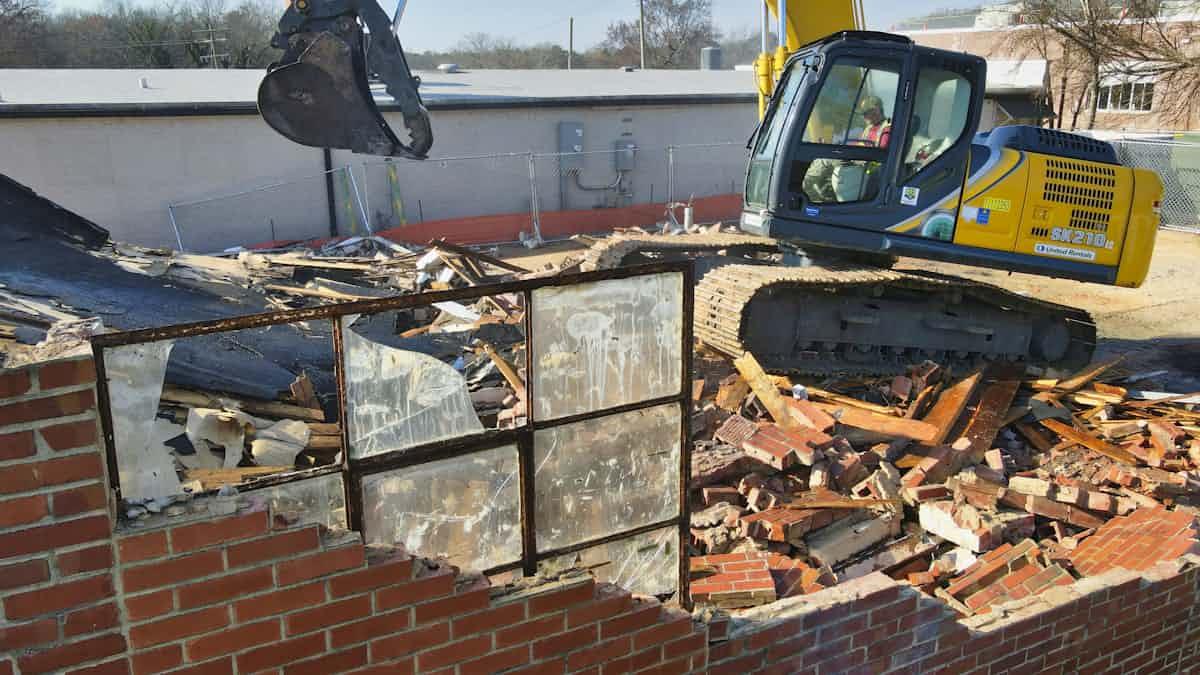
Machine demolition, using an excavator fitted with a breaker or grab, is faster and cheaper per square foot on larger structures with road access, but it needs clearance for the machine to enter and operate, and it carries a higher risk to adjoining walls if not controlled carefully. On a dense row-house plot with a narrow front, machine access is often simply not available, and the job defaults to manual regardless of what would otherwise be cheaper.
Most Karachi residential demolitions end up as a hybrid: machine work where access allows for the bulk of the structure, and careful manual work at the boundaries and shared walls where precision matters more than speed.
Why Costs Are Higher on Dense, Older Plots
Four conditions push demolition cost up on a given site, independent of its raw size.
Narrow access. A plot reached only through a lane too narrow for a truck or excavator means material has to be broken down and carried out by hand, which multiplies labour time.
Shared walls. Row houses and party-wall construction, common across older Karachi neighbourhoods, mean the demolition crew has to work carefully at every shared boundary to avoid damaging the neighbouring structure, which is slower than a free-standing demolition and carries genuine liability if done carelessly.
Structure age and construction type. Older masonry built without modern mortar standards can behave unpredictably during demolition, sometimes collapsing further than intended, sometimes proving far more stubborn than its apparent condition suggests. RCC frame structures need columns and beams cut rather than simply pushed over, which is slower and needs different equipment.
Utility density. A plot with multiple utility connections, an active water tank, overhead cabling running close to the structure, needs more careful sequencing and disconnection work before physical demolition can begin safely.
Debris Removal and Disposal
This is the item most often left off a lowball demolition quote, and it can be a substantial share of the total cost on a larger structure.
A single-storey house of around 1,500 sq ft covered area typically generates 60 to 100 tonnes of debris, brick, concrete, plaster and mixed waste, once broken down. A double-storey house of the same footprint generates roughly double that volume, and a genuinely large double-storey property, a G+1 of 4,000 sq ft or more of covered area, can generate 250 tonnes or beyond. Disposal cost depends on distance to an approved dump site, the number of truck loads required, and access for the trucks themselves.
Where disposal is included in the headline demolition rate, which is the more common arrangement and the one our rates above assume, it does not need separate budgeting. Where a contractor bills it as a genuinely separate line, common on larger jobs or where access is constrained enough to need extra handling, budget PKR 300 to 600 per tonne on top of the demolition labour rate, more where material has to be carried to a loading point by hand.
Ask specifically whether disposal is included in a demolition quote's headline number, or billed separately once the volume is known. The second arrangement is common and is not dishonest by itself, but it should be stated upfront, with an estimated tonnage, rather than discovered after the work has started.
Recoverable Material and Scrap Value
This is the part of demolition that most homeowners never think to ask about, and it is worth raising with any contractor before the first wall comes down.
A demolished structure contains material with genuine resale value: reinforcement steel from columns, beams and slabs, structural steel where present, timber from doors, window frames and roof trusses, aluminium and UPVC sections, copper wiring, and sometimes sanitary fixtures still in usable condition. Karachi has an active scrap and salvage market for all of these categories.
The honest way this works, and the way we handle it, is straightforward. We assess what is recoverable before demolition starts, sell it into the scrap market ourselves rather than letting a demolition crew clear it off site for their own account, and credit the realised value against the client's project cost as part of the payment schedule. It is a financial credit from a scrap sale, not a claim that old steel gets reused structurally in the new building, reusing demolition-grade reinforcement of unknown condition in new structural work would be a genuine safety compromise, and we do not make it. Our full guide on demolition scrap value and how it fits into a partial payment covers current scrap rates and exactly how the credit is calculated and applied.
Clients who hire unmanaged demolition labour directly typically never see this value at all. It leaves the site with whoever hauls the debris away, and the client pays full price for demolition while losing the salvage entirely.
How Demolition Fits Into Your Rebuild Timeline
Demolition is not a standalone event, it is the opening phase of a longer project, and it needs to be sequenced correctly against everything that follows.
Before demolition: confirm the new building plan is at least conceptually settled, notify SBCA or the relevant authority where required, disconnect utilities safely, and assess recoverable material.
During demolition: 1 to 3 weeks for a standard residential structure depending on size, storey count and access, longer for larger or multi-storey properties.
After demolition: site clearance and levelling, soil investigation if not already done, and handover into the foundation phase of the new build.
Our construction timeline guide covers the full build sequence from this point, including the 15 to 20 day per-phase buffer that Karachi's labour and holiday calendar makes necessary at every stage, demolition included. Friday half-days, Eid closures and occasional city-wide strikes affect a demolition crew exactly as they affect every other trade on a Karachi site.
Permits and Notifications
Demolition of a structure ahead of new construction generally needs to be notified to the same authority that will approve your new building plan, whether that is SBCA or a Cantonment Board, and any structure adjoining a shared wall carries an obligation to inform the neighbouring owner before work begins. Our SBCA building regulations guide sets out which authority governs which part of Karachi, since building without proper approval on either the demolition or the rebuild side of a project creates the same stop-work and resale risk either way.
Common Mistakes
Treating demolition as free or negligible. It is a costed phase with its own labour, machinery and disposal requirements, and pricing it as an afterthought is how it ends up as an unbudgeted extra.
No structural assessment before quoting. A price given from a plot size alone, without anyone looking at whether the structure is masonry or RCC frame, is a guess in one direction or the other.
Skipping utility disconnection. A genuine safety hazard, not a formality, and one of the more common causes of injury on unmanaged demolition sites.
No agreement on where scrap value goes. If this is not discussed before work starts, the material simply leaves with whoever is doing the demolition, and the value is gone.
Underestimating disposal volume and access constraints. The single biggest source of a demolition quote coming in over budget once work has started.
What We Do
Naffees & Sons has demolished and rebuilt across Karachi since 1972. We assess the structure before quoting, price demolition, utility disconnection and disposal as explicit line items rather than a single bundled number, protect shared walls on row-house and party-wall sites, and assess recoverable material before anything comes down so its scrap value is credited back to the client rather than disappearing with the debris. The price we quote at contract signing holds regardless of how fuel and disposal costs move afterward.
Frequently Asked Questions, Demolition Cost in Karachi
How much does it cost to demolish a house in Karachi? A single-storey masonry house typically costs PKR 75 to 150 per sq ft of covered area to demolish, and a double-storey RCC frame structure PKR 160 to 290 per sq ft. For a standard 200 sq yd plot with a single-storey house, total demolition cost generally runs PKR 120,000 to 300,000. The same plot with a double-storey ground-plus-one house costs meaningfully more, both because there is roughly twice the covered area and because the rate itself is higher, a real 300 sq yd double-storey demolition we recently quoted came to approximately PKR 1,000,000.
Does demolition cost include debris removal? Usually yes, in the rates quoted above, but it is worth confirming rather than assuming. Where a contractor bills it separately, common on larger jobs or constrained-access sites, budget PKR 300 to 600 per tonne on top, and a single-storey house of around 1,500 sq ft generates 60 to 100 tonnes of debris, a double-storey house of the same footprint roughly double that. Confirm whether disposal is included in the headline price or billed separately against an estimated tonnage.
Is demolition cheaper with a machine or by hand? Machine demolition is generally faster and cheaper per square foot on larger structures with vehicle access. On narrow plots or row houses with no machine access, manual demolition is the only realistic option regardless of cost, and it is also the more controllable method near shared walls.
Does the plot size affect demolition cost? Yes, but not in strict proportion. Smaller plots carry a higher effective rate because site setup, utility disconnection and safety measures cost roughly the same regardless of size. See the size-by-size table above for realistic totals from 80 to 1,000 sq yd.
Can I get money back from demolishing my old house? Yes, through the scrap value of recovered material, reinforcement steel, timber, aluminium and UPVC sections, and copper wiring all have resale value in Karachi's scrap market. This is a financial credit from a scrap sale, not old material reused structurally in the new building. Our demolition scrap value guide explains how the credit is assessed and applied.
Do I need permission to demolish a house in Karachi? Demolition is generally notified to the same authority approving your new building plan, SBCA for most of Karachi or the relevant Cantonment Board where applicable, and any shared wall carries an obligation to inform the neighbouring owner before work starts.
How long does demolition take? One to three weeks for a standard single or double-storey residential structure, depending on size, storey count and site access. Multi-storey structures and sites with constrained access take longer.
Should demolition and the new construction be the same contractor? It generally should, or at minimum tightly coordinated. A single accountable party carries responsibility for the utility disconnection, the shared-wall protection, the scrap assessment, and the handover into foundation work, rather than that coordination falling to the client between two separate parties.
Get a Demolition Quote
Naffees & Sons quotes demolition as an itemised phase, not a bundled guess, assesses recoverable scrap value before work starts, and coordinates the handover directly into your new build.
Get a Demolition and Rebuild Quote →
Related guides: