You have decided to demolish your old house and rebuild. That decision is the easy part. The demolition to construction process in Karachi that follows runs through NOC filing, three utility disconnections, teardown, clearance, and a handoff into foundation work, and most delay happens at the seams between these steps, not inside any single one. This guide lays out the operational sequence, in order, from the day you decide to demolish to the day your foundation is poured.
The Full Sequence at a Glance
Treat demolition and rebuild as one continuous project with eight stages, not two separate jobs handed to two separate contractors. Skipping a stage, or doing stages out of order, causes more delay in a Karachi demolition and rebuild than any pricing dispute or material shortage.
The sequence below assumes a standard plot with an existing single or double-storey structure, reasonable access, and a rebuild plan at least conceptually settled before demolition starts. Narrow-lane plots, shared-wall row houses, and unresolved ownership documents add time at nearly every stage, so treat these durations as a floor, not a ceiling.
| Stage | Typical duration | Who's responsible |
|---|---|---|
| Decision, design concept, and NOC filing | 2 – 6 weeks | Owner + architect/engineer, filed with SBCA or Cantonment Board |
| Utility disconnection (KE, SSGC, water/sewerage) | 1 – 3 weeks, can run parallel to NOC filing | Owner or contractor, on owner's account |
| Demolition itself | 4 days – 3 weeks, storey-dependent | Demolition contractor |
| Debris clearance and disposal | Overlaps tail of demolition, 2 – 5 days after | Demolition contractor |
| Site levelling and soil preparation | 3 – 7 days | Contractor, soil testing lab if needed |
| Boundary re-verification and setting out | 1 – 2 days | Surveyor / contractor's site engineer |
| Foundation excavation and pour | 2 – 5 weeks, plot-size dependent | Construction contractor |
| Handoff into grey structure | Immediate if same contractor; 1 – 4 weeks lost if not | Construction contractor |
Two stages on this table routinely run in parallel, and doing so is the easiest way to save real time. Utility disconnection does not need to wait for NOC approval and should start as soon as the demolition date is fixed. Soil testing, where warranted, can be arranged while debris clearance is still finishing. Demolition cannot start before utilities are disconnected, and foundation work cannot start before the site is levelled and boundaries re-verified.
The stage most often mismanaged is the handoff from demolition into foundation work. Using two separate contractors, one for teardown and one for the rebuild, costs owners real weeks that a single accountable contractor does not lose. We cover why further down.
Before You Touch the Building: NOC and Permissions
Demolition ahead of new construction in Karachi is not something you start on your own timeline. It has to be notified to the same authority that will approve your new building plan, the Sindh Building Control Authority (SBCA) for most of the city, or the relevant Cantonment Board or DHA authority where your plot falls under a different jurisdiction. Filing this alongside your new building plan submission is standard practice, and it is the step most first-time owners skip or discover too late.
This matters more in 2026. Following the July 2025 building collapse in Lyari that killed 27 people, Sindh's technical committee has declared 741 buildings dangerous province-wide, 588 in Karachi, and SBCA's enforcement around unsafe and unapproved structures has intensified sharply since (Dawn, 2026). An unnotified demolition is more likely to attract scrutiny now than two years ago.
The demolition NOC Karachi process is straightforward once you know it: submit notification of intended demolition alongside ownership documents and, beyond a simple single-storey masonry house, a structural note confirming the method is safe for the plot and its neighbours. Where a shared wall is involved, written notice to the neighbouring owner is expected first. Heritage-listed structures carry a stricter process, requiring a specific NOC from the Sindh Culture Department's heritage committee on top of standard SBCA notification (Dawn, 2019; Express Tribune). In an older, pre-1970s neighbourhood, confirm in writing that your structure carries no heritage designation first.
The building plan approval that follows takes 6 to 10 weeks for a complete, correctly formatted submission, and this clock usually does not start until the demolition notification and new plan are filed together. Incomplete documentation resets it entirely, the single most common cause of pre-construction delay. For the full jurisdictional breakdown and required documents, see our dedicated guide on demolition permission in Karachi.
Disconnecting Utilities: KE, SSGC and Water
This step most directly determines whether your demolition site is safe, and it is also the one most often left to the demolition labour crew to "handle informally," exactly how gas and electrical accidents happen on Karachi sites.
Electricity (K-Electric)
Contact K-Electric's customer service to formally request meter removal and disconnection ahead of demolition, rather than simply cutting a wire on site. This is a permanent disconnection tied to your account, and your security deposit is refundable once the meter is removed and the final bill is settled. Do this before any crew arrives, a live meter on a structure being torn down is a genuine electrocution risk, not a formality to skip because the house looks empty.
Gas (SSGC)
Sui Southern Gas Company requires a similar formal disconnection request rather than an informal shutoff at the meter. Gas lines left connected, or shut off only at a stopcock rather than isolated and capped by SSGC staff, are among the more dangerous conditions on an active site, particularly near mechanical breaking or any heat-generating tool. Confirm in writing that the line is disconnected at the main before demolition begins.
Water and Sewerage
Water connections and any active KWSC sewerage line should be capped or disconnected at the boundary before demolition starts, to avoid an uncontrolled leak and to avoid damaging the underground line during teardown. Where the plot has its own borewell or water tank, confirm its location is marked clearly, since striking a buried tank mid-demolition is a common and avoidable delay.
None of these disconnections needs to wait for SBCA approval. Start the utility disconnection before demolition process as soon as your date is roughly fixed, since K-Electric and SSGC both involve a request-and-inspection cycle taking one to three weeks on its own.
The Demolition Phase Itself
Once utilities are disconnected and your demolition notification is filed, the physical teardown can begin. How it happens depends on the structure and the site.
Manual Versus Mechanical Demolition
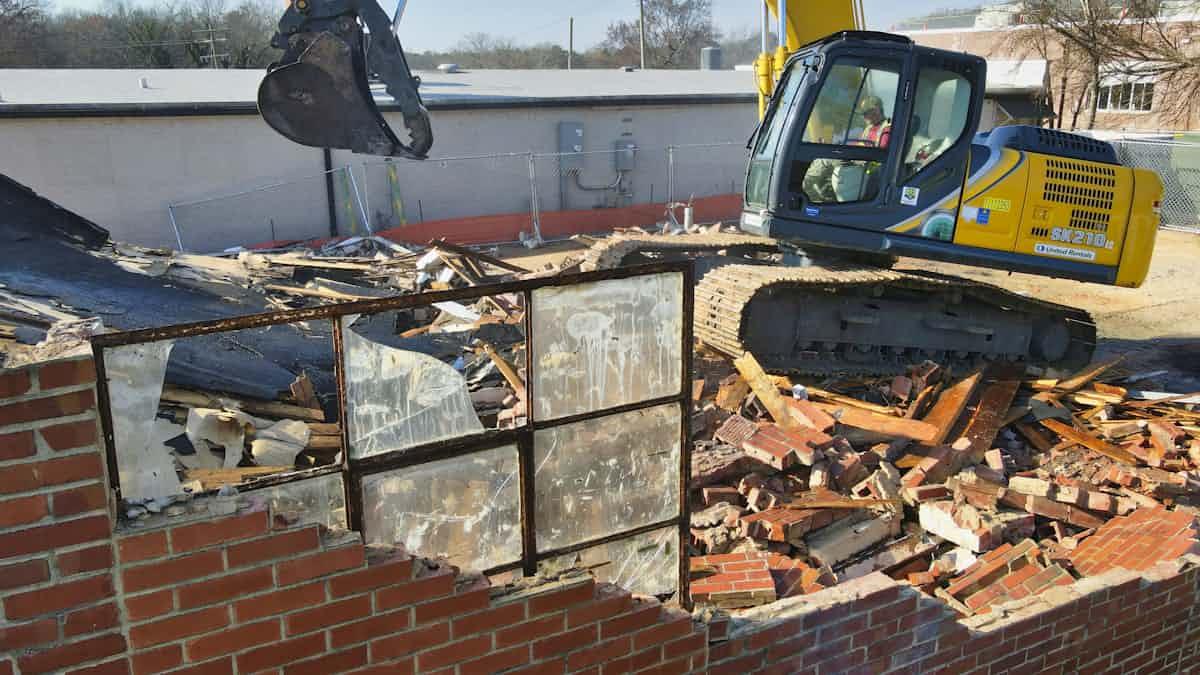
Most Karachi plots use a hybrid approach. Manual demolition, hand tools and a labour crew working systematically, is standard where access is too narrow for machinery, common across older, denser neighbourhoods. Mechanical demolition, an excavator fitted with a breaker, is faster and cheaper where road access allows it, but carries more risk to adjoining walls if not controlled carefully. A double-storey structure comes down floor by floor regardless of method, since the floor the crew stands on is scheduled for removal next. Our single-storey versus multi-storey demolition guide covers the sequencing gap in detail.
Safety and Neighbouring-Property Protection
Barricading, dust suppression by water spray, and hoarding where the site fronts a public lane are standard practice, not extras. On row houses, a shared or party wall belongs partly to the neighbouring property, and demolishing your side without protecting it risks liability well beyond your own boundary. Written notice to the neighbouring owner, and a structural check of the shared wall where uncertain, is worth the modest cost relative to the dispute it prevents.
Debris and Scrap Handling
A single-storey house of around 1,500 sq ft typically generates 60 to 100 tonnes of debris, a double-storey house of the same footprint roughly double that. Debris clearance Karachi logistics depend heavily on truck access, a narrow lane means material has to be hand-carried to a loading point, adding time and cost. Before debris leaves site, recoverable material, reinforcement steel above all, plus timber, aluminium and copper, should be sorted separately rather than mixed into general waste, since it carries resale value unmanaged labour otherwise takes with them. Our scrap value guide covers how that value is assessed and credited back.
A real 300 sq yd double-storey RCC-frame demolition recently quoted in Karachi, roughly 4,400 sq ft of covered area, came to approximately PKR 1,000,000, about PKR 227 per sq ft, consistent with the 8 to 14 working day timeline floor-by-floor sequencing requires (Naffees & Sons project data, 2026).
Site Clearance and Soil Preparation
Rubble being gone does not mean the site is ready for foundation work. Three things have to happen first, and skipping any is a common cause of foundation-stage problems that surface only after construction is underway.
Levelling. The site needs grading to a consistent level, removing pockets of loose fill, broken masonry, or uneven ground left by the teardown. An unlevelled site makes accurate excavation and formwork placement genuinely harder, and errors here compound at every stage that follows.
Soil testing, where warranted. Not every plot needs a fresh soil investigation, particularly where a prior structure of similar scale stood on the same footprint for decades without settlement issues. But a plot with a history of water pooling, a taller new structure, or land near reclaimed or filled ground, common in parts of Karachi's coastal and low-lying areas, should have bearing capacity confirmed before foundation design is finalised. It costs a few days, against a foundation problem far more expensive to fix afterward.
Boundary re-verification. Demolition sometimes removes the only physical reference points, an old boundary wall, a corner marker, confirming where your plot lines run. Before excavation starts, a surveyor or site engineer should re-verify boundaries against title documents, particularly on infill plots where a few inches of encroachment becomes a legal dispute.
Handoff to Foundation: Where Most Delays Happen
This is the point in the sequence where the largest, most avoidable delays occur, specifically when demolition and rebuild are handled by two separate parties rather than one.
A demolition contractor's job, by their own scope, ends when debris is cleared. A construction contractor's job begins when they mobilise onto a site already clear, levelled, and ready. Neither is contractually responsible for the gap between those definitions, so unless the owner personally manages it, that gap becomes something both can claim was the other one's job. In practice, this costs one to four weeks nobody is accountable for.
Using one contractor for both demolition and rebuild removes this gap entirely, since there is no handoff to fail. The same team that tears the structure down delivers a foundation-ready site and pours the foundation. Utility disconnection, scrap assessment, and boundary verification are planned as one continuous sequence, not negotiated separately with two parties who have never worked together.
Once the site is foundation-ready, the process moves into the phase our house construction timeline guide covers in full, foundation and grey structure running 4 to 9 months by plot size, followed by finishing and handover.
How Naffees & Sons Runs This Sequence
Naffees & Sons has run demolition-to-rebuild projects across Karachi since 1972, and the way we structure this handoff is deliberate: one contract, one accountable team, from the day the old structure comes down to the day the new one is handed over. We file demolition notification alongside the new building plan, coordinate KE and SSGC disconnection before any crew steps on site, and assess recoverable scrap before demolition starts so its value is credited back against the project.
A recent 300 sq yd project illustrates the sequence end to end. Demolition of an existing ground-plus-one house, roughly 4,400 sq ft of covered area, ran 12 to 14 working days, floor by floor given the RCC-frame construction. Site clearance, levelling, and boundary re-verification followed over the next week, parallel with the final stage of SBCA plan approval. Foundation excavation began within days, with no coordination gap, because the same team that demolished the structure poured the foundation.
Our services overview covers the full scope from demolition through turnkey handover, and our homepage has more on the history behind that record.
Questions to Ask Before Day One
Ask your contractor these questions before signing. Specific answers mean they have done this before; vague ones mean they are learning on your project.
- Is demolition and the rebuild covered under one contract, or two separate agreements? A single contract removes the handoff gap.
- Who files the demolition notification, and when relative to the new building plan? These should be filed together, not months apart.
- Who coordinates KE and SSGC disconnection, and on whose account? Confirm this happens before any crew arrives.
- What happens to recoverable scrap, and how is its value credited back to me? Ask for a documented process, not a verbal promise.
- Who is responsible for site levelling and boundary re-verification after clearance? This should be explicitly assigned.
- Is soil testing included, and under what conditions for my plot specifically? A generic answer either way is a warning sign.
- What is the realistic timeline from demolition start to foundation pour, with a buffer built in? Compare against the stage-by-stage table above.
- Can I see a past project where you handled both demolition and the rebuild for the same client? Ask for a real address, not a general claim.
Real Timeline: A Karachi Demolition-to-Foundation Case Study
A homeowner owned a 240 sq yd plot carrying an ageing single-storey masonry house and wanted a modern ground-plus-one rebuild. Here is how the sequence ran, week by week.
Week 1 to 2: Demolition notification filed alongside the new building plan, structural note attached. K-Electric and SSGC disconnection requests submitted in parallel.
Week 3: Both disconnections confirmed. Water connection capped at the boundary. Demolition crew mobilised.
Week 3 to 4: Manual and partial mechanical demolition, roughly 6 working days including barricading and debris breakdown. Reinforcement steel and salvageable timber sorted during teardown.
Week 4: Debris clearance completed over 3 truck loads. Site levelled. Boundary re-verified against title documents, no discrepancy found.
Week 5: Foundation excavation began, with SBCA plan approval clearing the same week, roughly 7 weeks from initial filing. No coordination delay at the handoff, because one contractor carried the project through every stage.
Total elapsed time from decision to foundation pour: just under 6 weeks, close to the fast end of what a single-storey plot with reasonable access should expect, achievable because utility disconnection and NOC filing ran in parallel.
Frequently Asked Questions
How much does a demolition to construction process cost in Karachi?
Cost depends on structure type, storey count, and plot size, budgeted as demolition, disposal, and the new build as distinct line items. Our demolition cost guide breaks this down by plot size from 80 to 1,000 sq yd, with a real 300 sq yd double-storey demolition recently costing approximately PKR 1,000,000 on its own, separate from rebuild cost.
How long does the full demolition to construction process take in Karachi?
From decision to foundation pour, a straightforward single-storey plot with reasonable access typically takes 5 to 8 weeks, including NOC filing, utility disconnection, demolition, and site clearance. A double-storey structure or narrow access extends this to 8 to 12 weeks. Foundation to handover then follows the separate timeline covered above.
Do I need a demolition NOC before tearing down my house in Karachi?
Yes. Demolition needs to be notified to the same authority approving your new building plan, SBCA for most of Karachi or the relevant Cantonment Board, and any shared wall carries an obligation to inform the neighbouring owner beforehand. Heritage-listed structures require a separate NOC from the Sindh Culture Department's heritage committee.
Is it safe to demolish a house without disconnecting utilities first?
No. A live electricity connection or an improperly isolated gas line on a structure being torn down is a genuine safety hazard, not a formality. Formal disconnection requests to K-Electric and SSGC, confirmed in writing before demolition starts, are standard on any professionally managed job.
Should demolition and rebuild be done by the same contractor?
It should, or at minimum be tightly coordinated. Splitting the two between parties creates a coordination gap at the handoff, site levelling, boundary re-verification, readiness confirmation, that neither is contractually responsible for, typically costing one to four weeks. A single accountable contractor removes that gap.
Is it better to demolish and rebuild, or renovate an existing structure?
It depends on the structure's condition. A structurally sound house needing cosmetic or layout updates is usually cheaper and faster to renovate. An older structure with genuine structural concerns, or one that cannot support additional floors, is usually better demolished and rebuilt, since renovation cost on a compromised building can approach rebuild cost once problems surface mid-project.
How do I choose a contractor for a demolition and rebuild project in Karachi?
Ask whether demolition and rebuild fall under one contract, how they coordinate utility disconnection and NOC filing, how they handle scrap value, and for a real reference where they managed both phases for the same client. Specific answers, not general reassurance, mean they have done this work before.
What happens to the debris and scrap from my old house?
Debris is cleared to an approved disposal site over several truck loads, a single-storey house generates 60 to 100 tonnes, a double-storey house roughly double that. Reinforcement steel, timber, aluminium and copper should be sorted and sold separately, credited back against project cost, as covered above.
Can I start building immediately after demolition finishes?
Not immediately. The site needs levelling, a debris sweep, boundary re-verification, and, where warranted, soil testing first. On a well-managed single-contractor project this adds roughly a week, but skipping it is a common cause of foundation-stage problems later.
Planning a Demolition and Rebuild in Karachi?
Get a free, no-obligation site visit and construction estimate from Naffees & Sons — Karachi's trusted builders since 1972. We handle demolition, permits, and the full rebuild under one contract.